
Oil Sight Glass, Oil Return Check Valve and Minimum Pressure Valve: Three Small Parts That Decide Compressor Reliability
Short answer: on a lubricated screw compressor, three small parts cause more unplanned downtime than most of the expensive ones — the oil sight glass, the oil return (scavenge) check valve on the separator line, and the minimum pressure valve. The sight glass decides whether you can trust your oil level reading. The return check valve decides whether oil gets back to the airend or ends up in your air line. The minimum pressure valve decides whether the separator can separate oil at all when the machine runs at low load.
All three fail quietly. None of them throws a fault code on its own. And because their symptoms overlap almost perfectly with a worn separator element, they are the three parts most often replaced by not being replaced — the element gets changed, the oil carryover comes back six weeks later, and the real fault is still sitting in the tank. This guide covers what each part does, the failure modes we see most often, and the field tests that separate one from another in under half an hour.
What each of the three parts actually does
The three parts sit within a metre of each other on most packages, which is exactly why they get confused. Their jobs are completely different.
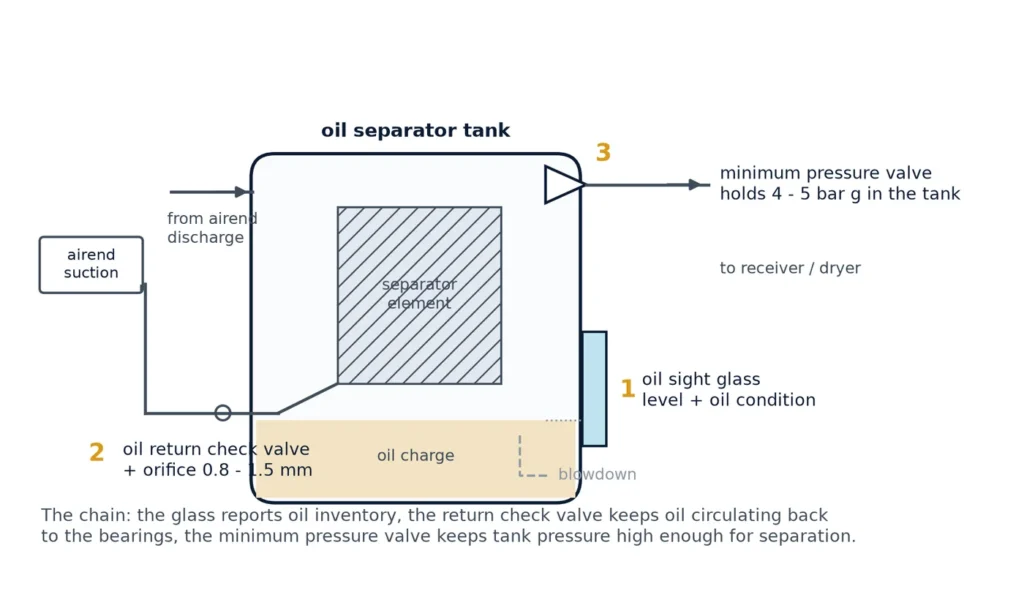
- Oil sight glass — a window into the separator tank. It shows standing oil level, and just as importantly oil condition: colour, foam, bubbles, and whether oil is draining back after shutdown.
- Oil return check valve — a spring-loaded check valve, usually combined with a fixed orifice of roughly 0.8–1.5 mm, on the small line that returns oil collected in the separator element back to the low-pressure side of the airend. It allows a trickle of oil one way and blocks compressed air the other way.
- Minimum pressure valve — a spring-set valve on the tank outlet that holds a minimum pressure (typically around 4–5 bar g) inside the separator tank, acts as a check valve against receiver air flowing back, and works with the blowdown solenoid to release tank pressure on shutdown.
In the air and oil circuit, the three parts form a chain: the sight glass reports the oil inventory, the return check valve keeps that inventory circulating back to the bearings, and the minimum pressure valve keeps the tank pressure high enough for the separator element to do its job. Break any link and the symptom appears at the other end of the chain.
Oil sight glass: read it correctly before you believe it
Most bad oil-level decisions are reading errors, not part failures. The level in the glass differs by 15–25 mm between a running machine and a stopped one, because running oil is spread across the cooler, the filter, the pipework and the airend. Read it while running and you will overfill; overfill and you get oil carryover that looks exactly like a failed separator.
Read the level with the machine stopped, pressure released, and five to ten minutes of settling time, on level ground. Then read the appearance, not just the height.
| What you see in the glass | Most likely cause | What to do |
|---|---|---|
| Level stable, oil honey to light amber | Normal | Log it at every service |
| Foam persists more than 30 s after shutdown | Wrong oil grade, water contamination, or overfill | Sample the oil; verify grade against the manual |
| Bubbles streaming while running, level dropping | Air entering the suction side or a leaking scavenge line | Pressure-test the return line; check the intake for loose fittings |
| Oil dark, opaque, or milky | Overheating (dark) or condensate (milky) | Check discharge temperature and drain condensate; change oil |
| Glass crazed, cloudy, or weeping at the seal | Age, heat and UV embrittlement of the plastic | Replace the glass — a false reading costs an airend |
| Level correct but the machine still trips on high temperature | Oil not circulating: blocked return line or stuck check valve | Go to the return check valve section below |
Sight glasses fail in a second, less obvious way: they are replaced with the wrong length or thread. A glass that is 10 mm too long reads high, the operator drains oil to bring the level back into range, and the machine runs 10 mm short for months. Always match the original part number, not just the thread size, and check that the glass sits at the same depth in the tank wall.
Oil return check valve: the smallest orifice in the machine
The separator element collects oil mist and drains it down as droplets. Those droplets cannot climb back up to the airend on their own, so a small line — usually with a sight tube or a short length of copper — takes them from the bottom of the element to a low-pressure point on the suction side. Two things sit in that line: a check valve, and a calibrated orifice.
The orifice is the whole point. It must be small enough that only a trickle of oil passes (a few litres per hour), and small enough that almost no compressed air escapes back to suction. Two failure modes follow directly:
- Blocked orifice. Carbon, sludge or a deformed filter element blocks the hole. Oil accumulates in the separator, the element saturates, and oil carryover starts — typically 20–60 ppm and rising, with oil visible in the downstream filter and sometimes in the dryer. Separator differential pressure may look normal at first, which is why the element gets blamed.
- Orifice drilled out or valve stuck open. Someone cleans the line with a wire or drills the hole to “make it flow better”. Now compressed air short-circuits back to suction: capacity drops, discharge temperature climbs, oil is pushed out of the tank faster than it returns, and the machine sounds slightly different at full load.
The check valve half of the assembly has its own failure: a weak or broken spring lets the valve chatter, and a worn seat lets air pass even when the valve is shut. Both produce the same result as an oversized orifice.
Field test, five minutes: run the machine to full pressure, stop it, and watch the return line. It should be warm to the touch and the oil in the sight tube should move. Then isolate and remove the check valve; blow through it in the free direction — it should pass air easily — and in the closed direction, where it should hold. Push a correctly sized pin or drill shank through the orifice to confirm the bore, never to open it up.
| Symptom | Return check valve state | Confirming test |
|---|---|---|
| Oil in the air line, element saturating early | Blocked orifice or stuck closed | Line cold after a load cycle; no oil movement in the tube |
| Low capacity, high discharge temperature | Stuck open, or orifice enlarged | Air passes freely in both directions; bore measures over spec |
| Rattling noise at the tank, oil level unstable | Broken spring or worn seat | Valve does not hold the closed direction; spring free length short |
Minimum pressure valve: three jobs in one body
The minimum pressure valve (MPV) looks like a simple spring-loaded valve, but it does three jobs at once, and each job fails differently.
- Hold tank pressure. The separator element only separates oil efficiently above roughly 4–5 bar g; below that, oil mist velocity through the element stays high and carryover rises sharply. The MPV keeps the tank above that floor even when the machine is unloaded or the downstream demand is small.
- Block backflow. It seats like a check valve, so air in the receiver does not drain back through the compressor when the machine stops.
- Work with the blowdown system. On shutdown, the blowdown solenoid vents the tank; the MPV and its seat determine how fast and how completely that happens.
Typical failures and what they look like in the field:
- Worn seat or soft spring — tank pressure will not hold at low demand. Oil carryover appears at part load and disappears at full load, which is the classic signature. Replacing the separator element never fixes it.
- Stuck closed or partially closed — tank pressure runs high, discharge temperature rises, the machine loads and unloads in an odd rhythm, and the safety valve may weep.
- Leaking seat — receiver air bleeds back through the stopped compressor, so the machine restarts against pressure, the motor draws high current at start, and the receiver pressure falls overnight with no leak in the plant.
- Wrong spring or shim pack — the valve opens at the wrong pressure. This happens when a valve is rebuilt from a generic kit instead of the model-specific one.
Field test: with the machine running at minimum demand, watch tank pressure on the controller. It should sit at the design minimum and rise only when demand rises. Then stop the machine and watch receiver pressure: a steady, slow decay from process leaks is normal; a fast drop that stops at the MPV setting points to the valve seat.
Why one failure looks exactly like another
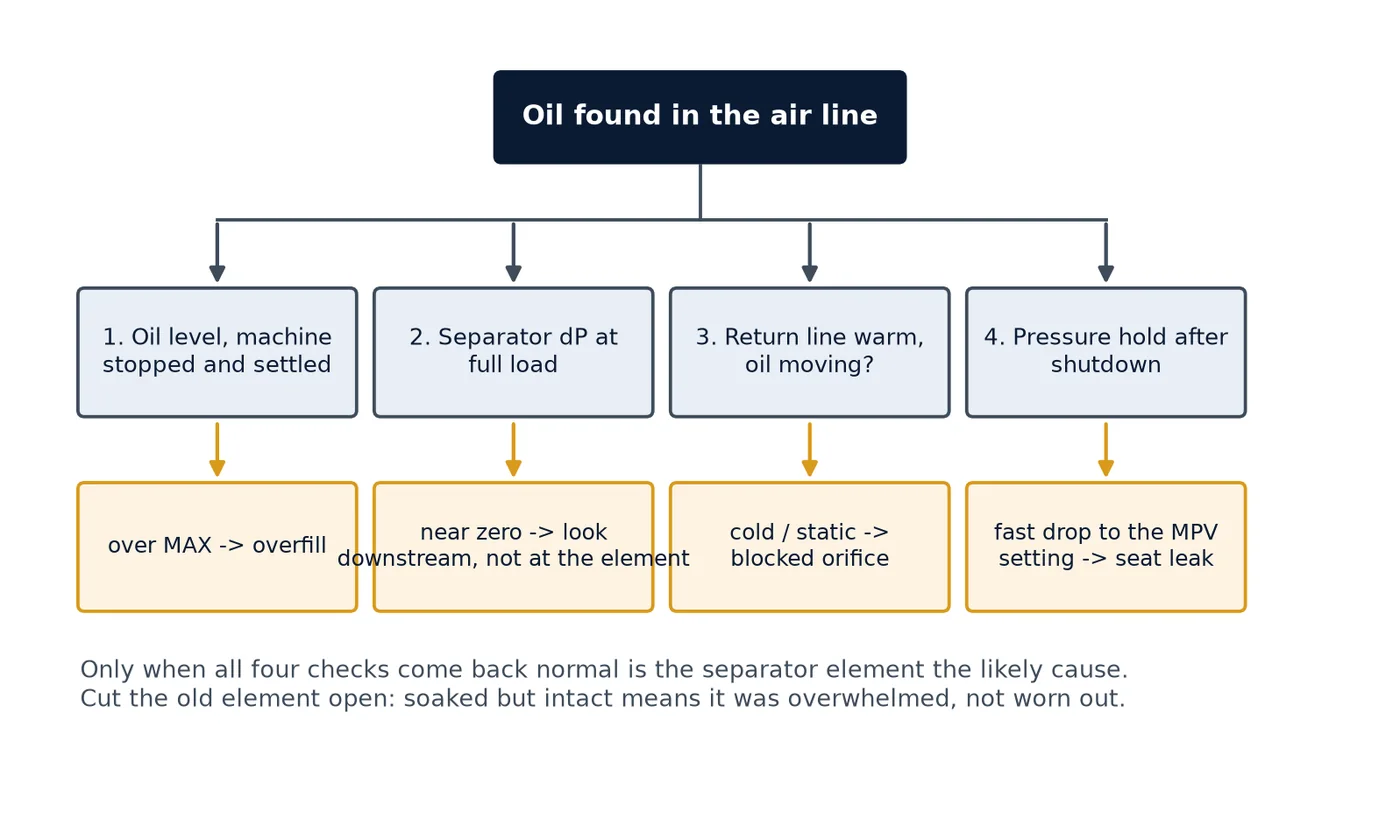
Oil carryover is the shared symptom, so diagnose in a fixed order. This sequence takes about half an hour and eliminates the cheap causes first:
- Confirm the oil level reading with the machine stopped and settled. Overfill is the single most common cause of “failed” separators.
- Check separator differential pressure against the manual limit. A low differential with heavy carryover points away from the element and towards the MPV or the return line.
- Check the return line for flow, temperature and a correct orifice bore.
- Pressure-hold test on the tank after shutdown — isolates MPV seat leakage from process leakage.
- Then suspect the element.
Two more parts belong on the suspect list because they mimic all three: a separator element that has been cleaned and re-seated with a damaged gasket, and a oil filter on bypass because it was never changed. Both push oil where it should not go.
Inspection routine that keeps all three honest
None of these checks needs a specialist. They need to be on a list and actually done.
| Interval | Task | Pass criterion |
|---|---|---|
| Daily | Read oil level and oil appearance | Between MIN and MAX, no persistent foam, oil clear |
| Weekly | Note tank pressure at low demand | Holds the design minimum (typically 4–5 bar g) |
| Weekly | Pressure-hold check after shutdown | Decay only at the rate of known plant leaks |
| Every 2,000 h | Remove and test the return check valve and orifice | Passes one way, holds the other, bore within spec |
| Every 4,000 h | Inspect MPV seat and spring; check blowdown | Clean seat, correct opening pressure, tank vents fully |
| Every element change | Inspect sight glass body and seal | No crazing, no weeping, correct length |
When to replace rather than clean
Carbon and sludge can be cleaned out of a return line; a changed bore cannot be restored, a spring cannot be re-tempered, and a crazed sight glass cannot be polished back to a true reading. Replace, do not repair, when:
- the orifice bore is larger than the manual figure, or the line has been drilled out at some point in the machine’s history;
- the check valve spring free length is below spec, or the valve does not hold the closed direction;
- the MPV seat shows a visible groove or the opening pressure is off by more than about 0.5 bar;
- the sight glass is cloudy, crazed, or the seal weeps after re-tightening.
These are low-cost parts relative to what they protect. If you keep one spares kit per model on site, put these three in it. Related reading: replacement intervals and rejection criteria for air, oil and separator filters, and the symptom-to-cause troubleshooting map.
Frequently asked questions
Why does my compressor use oil but show no leak and no smoke?
Oil leaves through the air line as vapour or mist, not as a visible leak. Check oil level reading method first (overfill), then separator differential pressure, then the return check valve orifice. A machine that consumes oil only at part load is usually a minimum pressure valve problem, because tank pressure drops below the level where separation works.
Can I clean the oil return check valve orifice with a wire?
Use a wire or pin only to confirm the bore, never to enlarge it. The orifice is calibrated to pass a trickle of oil while blocking air. Opening it by even a fraction of a millimetre sends compressed air back to suction, which costs capacity and raises discharge temperature — and it looks like a totally different fault afterwards.
How can I tell a failed minimum pressure valve from a worn separator element?
Run the machine at low demand for ten minutes. If oil carryover appears at part load and clears at full load, suspect the minimum pressure valve. If carryover is present at all loads and separator differential pressure is above the manual limit, the element is the more likely cause. A pressure-hold test after shutdown confirms whether the valve seat leaks back.
What oil level should the sight glass show?
Between the MIN and MAX marks with the machine stopped, pressure released and five to ten minutes of settling time. The running level is always lower and is not a valid reference for topping up. On most packages the correct standing level is around the middle of the glass, not at the top.
Does the minimum pressure valve setting differ between 8 bar and 16 bar machines?
Yes. The valve is set relative to the machine’s working pressure and to the pressure the separator element needs for efficient separation, so springs and shims are model-specific. Always fit the valve specified for the model and pressure rating; a valve rebuilt with a generic kit can open early and cause carryover, or late and cause high temperature.
These answers cover the common cases. Machine-specific limits always come from the manual of the unit in front of you.
Need the right small parts, first time?
Sight glasses, return check valves, minimum pressure valves and separator elements for screw compressors — send us the model plate and the part you are replacing, and we will match it.