
Air Compressor Auto Drain Valves: Types, Sizing and Four Failure Modes
Short answer: an auto drain has one job — remove liquid water from a compressed air system without wasting air — and most drain problems come from choosing the valve family before calculating how much condensate there actually is. Get the condensate load in litres per hour first, then pick between a timed solenoid, an electronic level-sensing valve, a mechanical float trap or a zero-loss drain. A drain that is oversized dumps air; a drain that is undersized passes water downstream into the dryer and the oil; a drain that is right for the flow but installed at the wrong point does both.
This guide covers the four families with their real weak points, the three numbers that decide sizing, where each drain belongs on a lubricated screw compressor, and the four failures you will actually meet in service — with the checks that separate them.
How much water you are actually draining
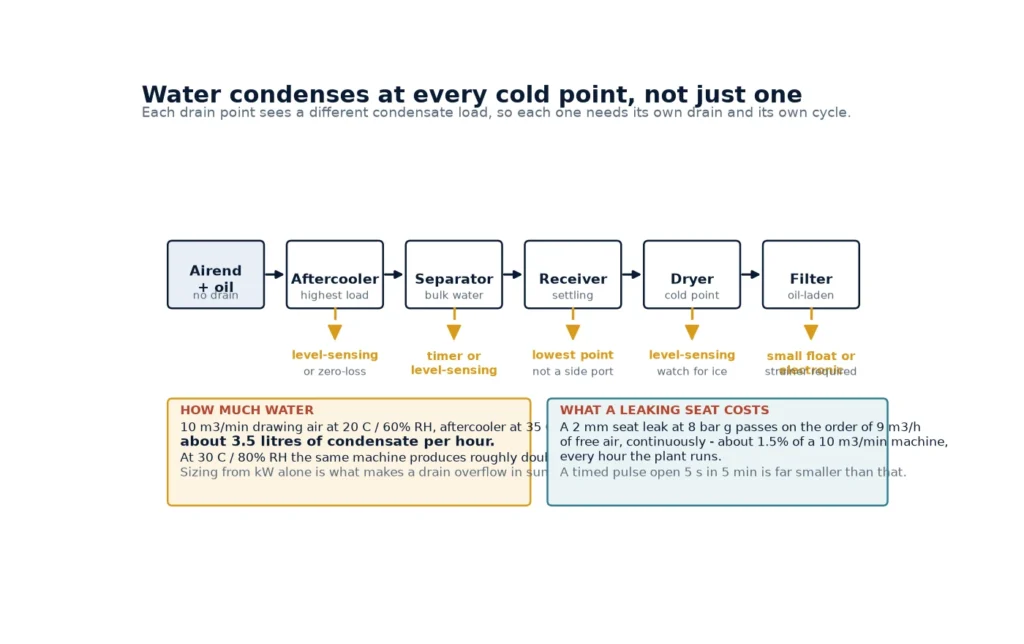
Condensate load is set by how much water vapour enters with the intake air and how cold the air gets after compression. Take a 10 m³/min machine drawing plant air at 20 °C and 60% relative humidity, with the aftercooler bringing the air down to about 35 °C. The intake air carries roughly 8.7 grams of water per kilogram of dry air; saturated air at 35 °C and 8 bar gauge carries under 4 grams. The difference — around 4.8 grams per kilogram, on roughly 720 kg of dry air per hour — leaves about 3.5 litres of liquid water per hour to be removed.
Raise the intake to 30 °C and 80% relative humidity and that figure roughly doubles. This is why a drain that worked all winter overflows in July, and why sizing from the machine’s power rating alone is a mistake: two identical compressors in a coastal plant and a dry inland plant produce very different amounts of water. Use your own humidity and aftercooler outlet temperature; the ratio between them is what matters.
The four families, and what each one is bad at
Every automatic drain on the market is one of four mechanisms. They differ in how they decide that water is present, and that decision method — not the price bracket — is what determines how it behaves on your system.
| Family | How it decides to open | Where it suits | Weak point in service |
|---|---|---|---|
| Timed solenoid | A timer opens the valve for a set number of seconds on a fixed cycle | Steady loads, small receivers, low-cost installations | Blind to actual water: dumps air when dry, passes water when the load rises |
| Electronic level-sensing | An electrode or capacitive probe detects high level and opens until low level | Variable condensate load, dryers, receivers | Probe fouling with oil sludge or rust gives false high or false low readings |
| Mechanical float trap | A float rises with level and opens a pilot valve | Dirty condensate, high sediment, no electrical supply | Orifice blockage by scale; float sticking after long idle periods |
| Zero-loss (level-sensing, no air loss) | A chamber fills, then a motorised or pilot valve discharges it without venting compressed air | Dryers and points where air loss matters over years | Slower discharge; needs a strainer, and a blocked strainer looks like a stuck valve |
A fifth variant — a manual ball valve cracked open — is still common, and it is not a drain: it passes air continuously and passes water unpredictably. When you find one, treat it as a leak to be fixed rather than a design choice.
Sizing: three numbers, in this order
Drain sizing on a compressor system is simpler than it looks once the numbers are in the right order. Condensate load sets the flow capacity, pressure sets the discharge rate through the orifice, and chamber volume sets how often the cycle repeats.
| Number | How to get it | What it decides |
|---|---|---|
| Condensate load (L/h) | Intake humidity and temperature versus aftercooler outlet temperature, per m³/min of free air | Valve size and cycle budget |
| System pressure (bar g) | Gauge at the drain point, not at the compressor outlet | Discharge rate while open — pressure drop along the pipe matters |
| Chamber or bowl volume (L) | Manufacturer’s figure for the drain body | How much fits per cycle, so how much time the valve needs |
| Duty per cycle (s) | Volume to dump divided by discharge rate, with a margin | Timer setting, or the opening time of a level-sensing valve |
Worked example: with about 3.5 L/h of condensate, a chamber of 0.4 litre fills in roughly seven minutes. If the valve discharges that chamber in three seconds at the drain point pressure, the valve is open for three seconds every seven minutes — under 1% duty. That is comfortable for any of the four families. The case that needs care is a system with a large condensate load and a small chamber: the cycle shortens until a timer-driven valve is open almost continuously, and the air loss becomes the dominant cost.
Where each drain belongs
Water is removed at the coldest point in the system, and there is more than one cold point. A single drain at the receiver is the most common layout and the least effective, because most of the water has already condensed upstream of it and the rest condenses downstream.
| Location | What collects there | Suitable type | Note |
|---|---|---|---|
| Aftercooler separator / moisture trap | The bulk of the condensate | Level-sensing or zero-loss | Highest water rate in the whole system |
| Air receiver | Water carried over from the separator plus pipe condensate | Timed solenoid or level-sensing | Needs a drain at the lowest point, not on a side port |
| Refrigerated dryer | Water condensed by the dryer’s own cooling | Level-sensing, small orifice | Icing at the drain is a winter failure, not a valve fault |
| Coalescing / precision filter bowl | Small volumes of oil-laden water | Small electronic or float trap | Oil sludge fouls probes; strainer is mandatory |
| Low points and drip legs in the ring main | Pipe condensate | Manual or float trap | Drains at risers are often missing entirely |
The four failure modes
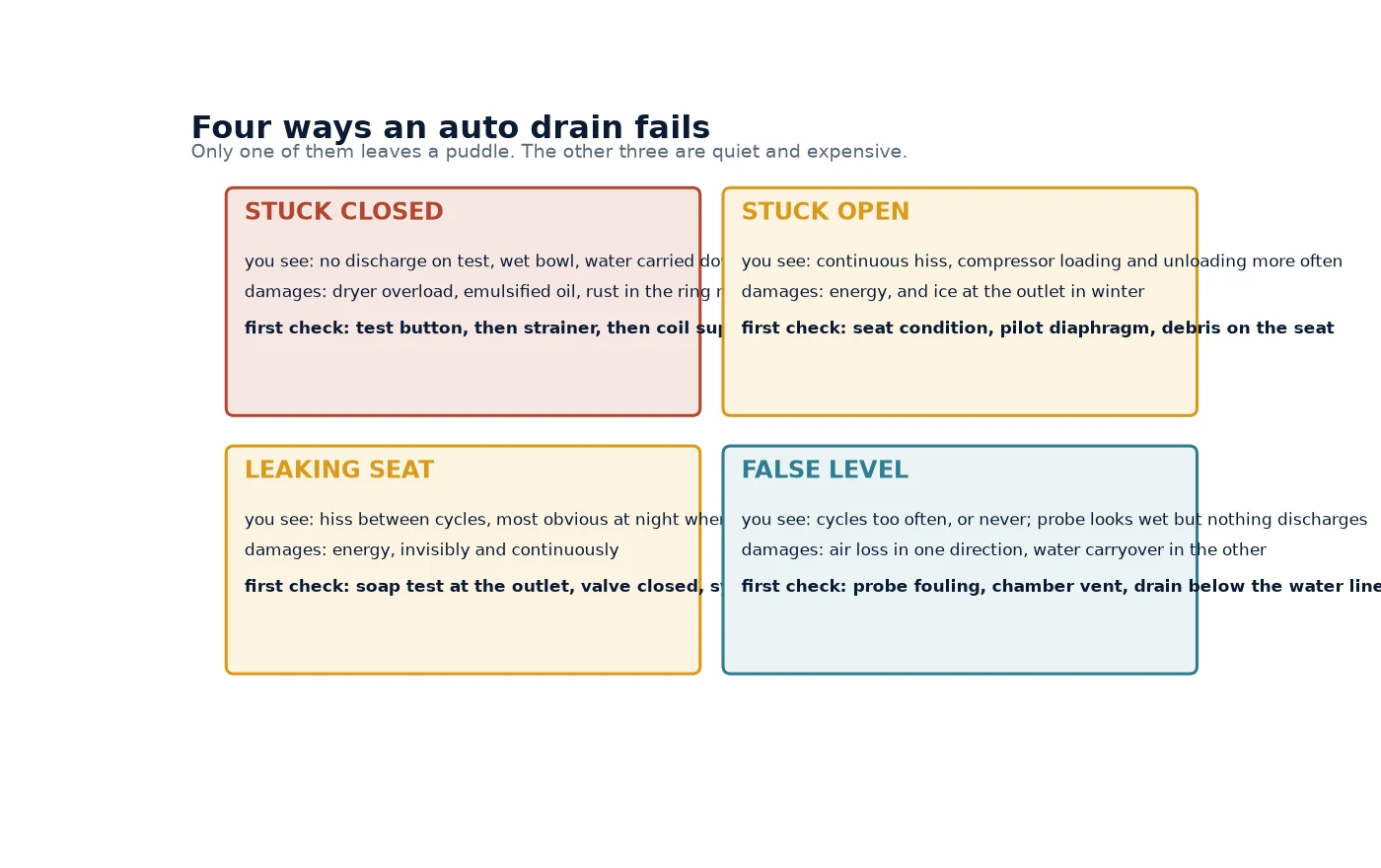
Almost every drain complaint reduces to one of these four. They are worth learning in order, because the damage each one does is different and only one of them is visible as a puddle.
| Mode | What you see | What it damages | First check |
|---|---|---|---|
| Stuck closed | No discharge on test; water in the filter bowl, wet air downstream | Dryer overload, emulsified oil, rust in the receiver, corrosion in the ring main | Manual test button, then strainer, then coil or solenoid supply |
| Stuck open | Continuous hiss at the drain; compressor loads and unloads more often | Energy, and in winter, ice at the discharge point | Seat condition, pilot diaphragm, and debris holding the seat off |
| Leaking seat | Intermittent hiss between cycles, more obvious at night | Energy, slowly and invisibly; a 2 mm leak passes on the order of 9 m³/h of free air continuously | Soap test at the outlet, with the valve closed and the system loaded |
| False level or false dry | Cycles too often, or never; probe wet but no discharge | Either air loss or water carryover, depending on direction | Probe condition, chamber vent, and whether the drain is fitted below the water line |
The air loss that is not the timer's fault
Timed drains get blamed for wasting air, and a badly set timer does waste some. But the arithmetic usually points elsewhere: a drain open for five seconds every five minutes passes about 1.7% of its open-flow rate, which on a small orifice is a fraction of a cubic metre per hour. A seat that leaks continuously through the same orifice passes that flow 100% of the time — roughly 9 m³/h of free air, near enough 1.5% of a 10 m³/min machine, running every hour of the year.
So the sequence when someone reports "the drain is eating my air" is: close the isolation valve and confirm the hiss stops, soap-test the seat, then look at the timer. On a zero-loss drain the equivalent check is the chamber vent and the strainer, because a blocked strainer keeps the chamber from filling and a vent that cannot breathe keeps it from emptying.
A test routine that takes five minutes a week
Automatic drains fail quietly, which is why they get ignored until the dryer packs up. Five minutes a week prevents nearly all of it:
- Press the test button on every drain and watch the discharge. A weak or dirty sputter means the strainer or the orifice is partly blocked.
- Listen between cycles with the system loaded. Any continuous hiss is a seat leak, not a timer setting.
- Look at the discharge point in winter. Ice means water is sitting in the outlet, and on a dryer drain it means the drain is cycling too slowly.
- Drain the receiver manually once a month and measure what comes out. If the auto drain is doing its job, the manual drain yields almost nothing.
- Log the cycle on timed drains twice a year, against the season. The setting that suited January is short in July.
Before you replace a drain, measure four things
Replacing a drain without measuring gets you a new drain with the same problem. Record: the pressure at the drain point with the system loaded; the volume discharged in one manual cycle, in litres; what the water looks like — clear, rusty, or black with oil; and the electrical supply and timer setting if it is a timed unit. Those four answers decide whether the fix is a valve, a strainer, a probe clean, or a second drain point further upstream.
If the water comes out black and oily, the drain is not the fault — look at separation first, starting with the oil-gas separator element and the return line. If the water is rusty, the receiver and the ring main are corroding and the drain points are too few. Our symptom-to-cause troubleshooting guide covers the wider picture, and the drain range itself is under automatic drain valves, with bowl and strainer options under precision filter housings.
Frequently asked questions
How often should a timed drain open?
Roughly often enough to empty the chamber before it overflows, and no more. Calculate the fill time from condensate load against chamber volume, then set the interval to about two thirds of it and the opening time to whatever empties the chamber with a margin. If the resulting duty is above a few per cent, the chamber is too small for the water load and a level-sensing valve is the better choice.
Do I need a drain on the receiver if I already have one on the aftercooler?
Yes. The aftercooler separator catches most of the water, but the pipe run to the receiver condenses more, and the receiver is where it settles. A receiver drained only by a side port keeps a layer of water at the bottom that eventually carries over in slugs.
Why does my drain freeze in winter?
Water is sitting in the outlet instead of leaving it. Either the drain cycles too rarely for the condensate load, or the discharge line runs horizontally and holds water. Shorten the outlet, run it vertically to a safe point, and check the cycle interval against the season.
Is a zero-loss drain always worth it?
It is worth it where the drain point sees a lot of open time or where the leak risk is high, and it is overkill where the condensate load is small and the cycle is short. The decision is arithmetic, not principle: compare the air a timed drain passes in a year, including a leaking seat, with the cost of the valve. Every zero-loss drain also needs a clean strainer to work at all.
Can one drain serve several points?
Only if the points are at the same pressure and slope down to the drain, and in practice that means a single manifold with a common low point. Water does not travel upward or against pressure, so a drain tied to a higher point drains the air, not the water. Separate drains per cold point are the reliable answer.
These answers cover the common cases. Machine-specific limits always come from the manual of the unit in front of you.
Tell us where the water is coming from
Send the drain point that is giving trouble, the pressure there, roughly how much water comes out in one manual cycle, and whether it is clear, rusty or oily. That is enough to say whether you need a different valve family or an extra drain point.