
Airend Rebuild or Replace: How to Judge a Screw Compressor Airend
Short answer: rebuild when the wear sits in the bearings, shaft seal and gaskets and the rotor flutes and bore are still sound. Replace when the rotors or the bore are scored, pitted or eroded, when the housing has run hot enough to lose its fit, or when clearances are already at the limit and a rebuild would only postpone the same failure by a few months.
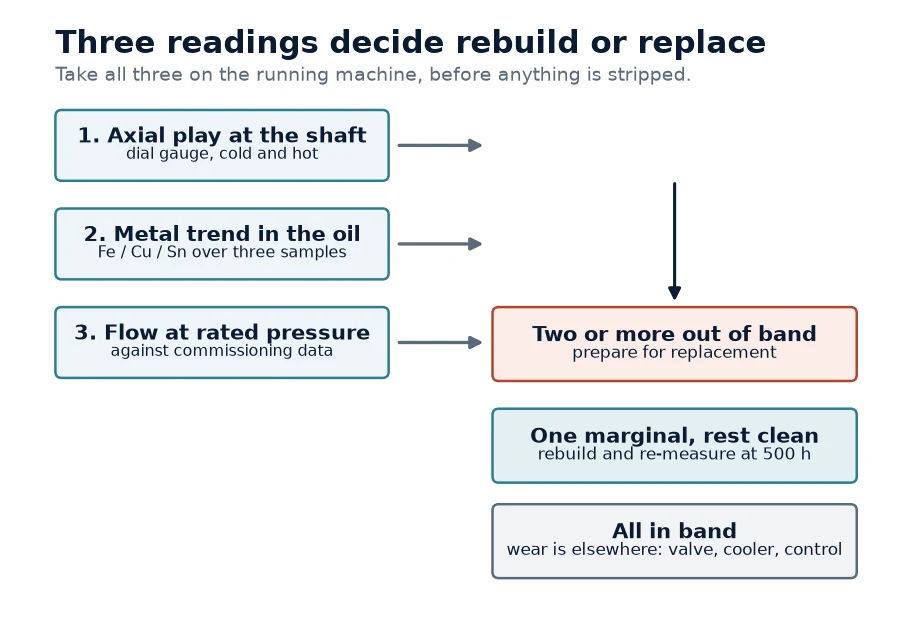
Three readings carry that decision, and none of them is the sound the machine makes: axial play at the rotor shaft, the metal trend in the oil analysis, and the flow the unit still holds at rated pressure. Everything else on this page is how to take those three readings and what they mean.
What the word actually covers
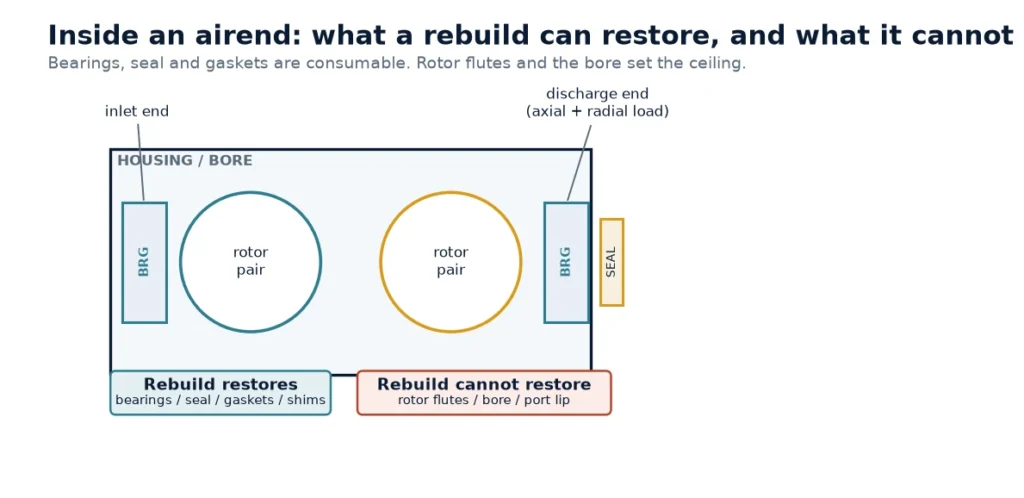
On an oil-injected screw compressor the airend is the compression chamber plus everything that keeps it turning and sealed: the male and female rotor pair, the housing or bore that surrounds them, a discharge-end bearing set that carries both radial and axial load, an inlet-end bearing, the shaft seal that keeps oil out of the compression chamber, and the gaskets and O-rings that close the castings. Some designs add timing gears to hold the rotor clearance.
Only part of that list is consumable. Bearings, seals and gaskets are made to be renewed. The rotor flutes and the bore are the parts that set the ceiling on what any rebuild can restore, and that ceiling is what the rebuild-or-replace question is really about.
| Component | How it normally wears | What the operator notices | What to measure |
|---|---|---|---|
| Rotor flutes | Erosion and pitting at the discharge end, contact scoring if clearances closed | Flow falls while power stays high; discharge temperature climbs | Lobe surface photos under good light; clearance at the discharge end |
| Housing bore | Erosion at the discharge port, corrosion from water carried over in the oil | Temperature creep, metal in the oil, slow loss of pressure stability | Bore diameter at three depths, port erosion depth |
| Discharge-end bearings | Fatigue spalling, cage wear, loss of preload | Rumble that appears at unload, axial movement of the rotor | Axial play with a dial gauge; Fe, Cu and Sn in the oil report |
| Inlet-end bearing | Radial wear under belt or coupling load | Noise that follows load, rising vibration | Radial play, vibration spectrum at 1x and bearing frequencies |
| Shaft seal | Lip hardening, groove on the shaft journal | Oil consumption up, oil mist in the air line, oil in the separator drain | Oil carryover rate against the separator’s normal figure |
| Gaskets and O-rings | Compression set, hardening | External weep, pressure drop at the joints | Visual on strip-down |
| Timing gears, where fitted | Backlash growth, tooth polish | Rattle at low speed, metal in the oil | Backlash at four points of rotation |
The pattern matters more than any single item. A machine with scored rotors and perfect bearings is a different case from a machine with clean rotors and a failed discharge bearing, and the two lead to opposite answers.
The three readings that carry the decision
Take these before any strip-down. They are cheap, they can be taken on a running machine, and they are what an airend supplier will ask for anyway.
- Axial play at the rotor shaft. With the coupling guard off and the rotor at rest, push and pull the shaft axially and read the movement on a dial gauge. New units sit in a narrow band set by the OEM; wear shows as movement beyond that band, and movement that changes between cold and hot is a bearing that is already loose.
- The metal trend in the oil. One oil sample proves nothing. Three samples over several hundred hours do: iron climbing with copper and tin says bearing material is going, while iron alone with silicon says dirt is coming in through the intake. Water and the ISO cleanliness code belong in the same table, because wet oil is what corrodes the bore.
- Flow at rated pressure. Compare against the commissioning figure or the nameplate flow at the same pressure, corrected for ambient and for the speed the machine actually runs at. A drop of a few percent over years is wear. A drop of ten percent or more with no change in demand is the compression chamber itself.
If your enquiry is only about identifying the part that goes with the airend, the six measurements in this guide to identifying a part are the ones to send first.
Reading the numbers against a limit
The table below is the form the decision takes. The figures in it are typical for oil-injected airends of the 5 to 250 kW range; the manual and the serial-specific data sheet for your unit override every one of them.
| Check | Where to measure | Typical new | Where it starts to matter |
|---|---|---|---|
| Axial play | Discharge-end shaft, cold | 0.05 – 0.15 mm | Beyond the OEM band, or a hot reading more than 0.05 mm above the cold one |
| Radial play | Inlet-end shaft, cold | 0.03 – 0.10 mm | Above the band, with noise that follows load |
| Rotor-to-rotor clearance | Between flutes, feeler or lead wire | 0.05 – 0.15 mm | Below the OEM minimum: contact is already happening |
| Discharge port erosion | Port lip, visual and depth | none | Any visible step at the lip |
| Oil iron (Fe) | Oil analysis, trend | under 20 ppm | Rising across three samples, or above 50 ppm |
| Oil copper and tin (Cu, Sn) | Oil analysis, trend | under 10 ppm | Any upward trend: bearing cage and shell |
| Water in oil | Karl Fischer or crackle test | under 200 ppm | Above 500 ppm: bore corrosion risk |
| Flow at rated pressure | Against commissioning data | 100 % | Below 90 % with unchanged demand |
Two readings out of band and the answer is usually replacement. One reading marginal with everything else clean is usually a rebuild, with the marginal item measured again after 500 hours.
When replacement is the only honest answer
A rebuild renews bearings, seals and gaskets. It does not put material back on a rotor or a bore. Once any of the following is true, a rebuilt unit will run, and will fail again early:
- Rotor contact has removed material, not just polished it. Scoring that you can feel with a fingernail changes the clearance and the compression path.
- The discharge port lip is eroded into a step. The port shape is what sets the internal compression ratio, and a worn lip costs flow permanently.
- The housing has been overheated: discolouration, a bearing seat that will not hold preload, or a bore that is no longer round within the OEM tolerance.
- The casting is cracked, or a bearing seat has spun.
- Clearances are already at the reject limit before the rebuild starts.
- The model is obsolete and no bearing, seal or gear set exists for it any more. This is the case where the honest answer is a current production airend that fits the same frame.
The same logic applies to valves: if the seat and the body are gone, a repair kit cannot help. That comparison is set out in repair kit, rebuild or replace for an intake valve, and the judgement is the same shape.
What goes into a rebuild, and what to send with the enquiry
A normal airend rebuild covers: discharge-end and inlet-end bearings, the shaft seal, the full gasket and O-ring set, and on some models the timing gears or the rotor preload shims. Anything beyond that list is machining, and machining is what turns a rebuild into a reconditioning job with a different risk profile.
With the enquiry, send: the model and serial number as stamped on the airend nameplate, a photo of that plate, photos of the rotor flutes at the discharge end, the axial play reading with the gauge visible, the last two oil reports, and the flow and pressure the machine was commissioned at. Six photos and one number save a week of email.
Fitting it back, and the first 100 hours
Most early airend failures after a rebuild are fitting faults, not rebuild faults. The checklist that prevents them:
- Clean the coupling faces and check alignment with a dial gauge, not by eye. On a direct drive the tolerance is tight, and a rebuilt unit sits differently from the one that came out.
- Never let the unit turn without oil. Prime the oil circuit, or crank briefly with the inlet closed until pressure shows.
- Change the oil and the oil filter at the same time, and clean the separator housing. Old oil carries the metal that just destroyed the last bearing.
- Log oil temperature at 30 minutes, 2 hours, 8 hours, 24 hours and 100 hours. A rebuilt airend runs slightly warmer while the bearings settle; a reading that climbs instead of settling is a fitting problem.
- Take an oil sample at 500 hours, and treat the first sample after a rebuild as the new baseline.
Temperature is the cheapest early warning you have. The order to work through when it climbs is in the high discharge temperature check order, and it should be followed before anything is stripped.
The maintenance choices that decide how long the next one lasts
Two machines of the same model, run for the same hours, can differ by years of airend life. The difference is almost always in five habits:
- Oil changes done on condition, not only on the calendar. Oil that has lost its oxidation reserve varnishes the rotors, and varnish closes clearances.
- Separator and filter changes on the schedule in filter and separator replacement intervals. A loaded separator raises the pressure differential across the chamber.
- Cooler kept clean. High inlet oil temperature shortens bearing life faster than any other single factor.
- Water kept out. Condensate in the oil corrodes the bore, and a corroded bore cannot be rebuilt. The oil sight glass and the drain are how you see it early, as described in this guide to the sight glass, return check valve and minimum pressure valve.
- Load profile respected. A machine run for long stretches at very low load runs cold, and cold oil carries water. If the unit is inverter-driven, the parts and settings that differ are listed in VFD versus fixed speed parts.
Frequently asked questions
Can an airend be rebuilt on site?
The mechanical work is workshop work: pressing bearings, setting preload and measuring clearances needs a press, a clean bench and measuring tools. What happens on site is removal, and after refitting, alignment, oil priming and the temperature log. Plan the site work around that split.
How do I know the noise is the airend and not the motor?
Isolate. On a belt drive, slacken or remove the belts and turn the airend by hand; on a direct drive, separate the coupling and run the motor alone for a few seconds. Noise that disappears with the coupling open is not the motor. Then compare the vibration spectrum with the bearing frequencies of the airend, not the motor.
Is a rebuilt airend as good as a new one?
A rebuild restores bearings, preload, seal and clearances to specification. It does not restore rotor or bore surfaces. On sound rotors a rebuild is a full-life repair; on eroded rotors it is a repair that will be repeated, which is why the rotor photos come before the decision, not after.
Can I keep running with slightly worn bearings?
Not safely. Bearing wear moves the rotor axially, and once the rotor touches the housing the damage moves from a bearing set to a rotor pair. The cost of the decision changes by an order of magnitude at that point, so a reading at the edge of the band is a reason to schedule, not to wait.
Which oil analysis numbers actually matter for an airend?
Iron for the rotors and housing, copper and tin for the bearing cages and shells, silicon for intake dirt, water for corrosion risk, and the ISO cleanliness code for the whole picture. Trends across three samples decide far more than any single number.
Does inverter operation wear an airend faster?
It changes the duty, not automatically the wear rate. Low-speed running reduces bearing load but also reduces oil flow and temperature, which is where condensate and varnish come from. The parts and settings that differ between inverter and fixed-speed machines are covered in the VFD comparison linked above.
These answers cover the common cases. Machine-specific limits always come from the manual of the unit in front of you.
Have an airend number and six photos?
Send the model, the serial plate, the axial play reading and the rotor photos, and we will tell you which way the decision falls before anything is stripped.