
50 Hz to 60 Hz: What Changes When a Screw Compressor Runs at 460 V
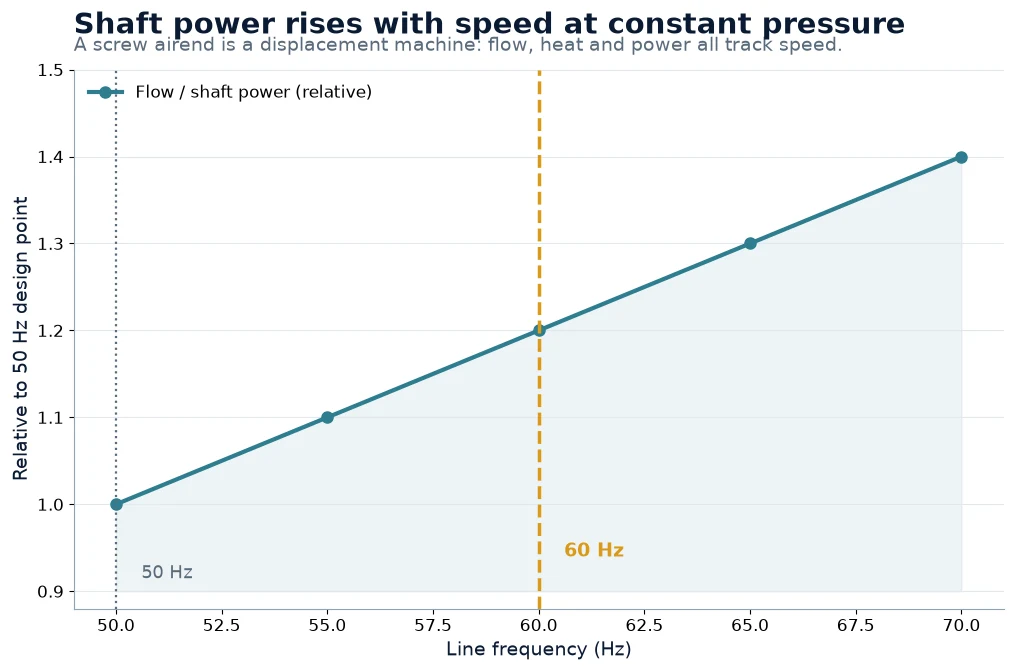
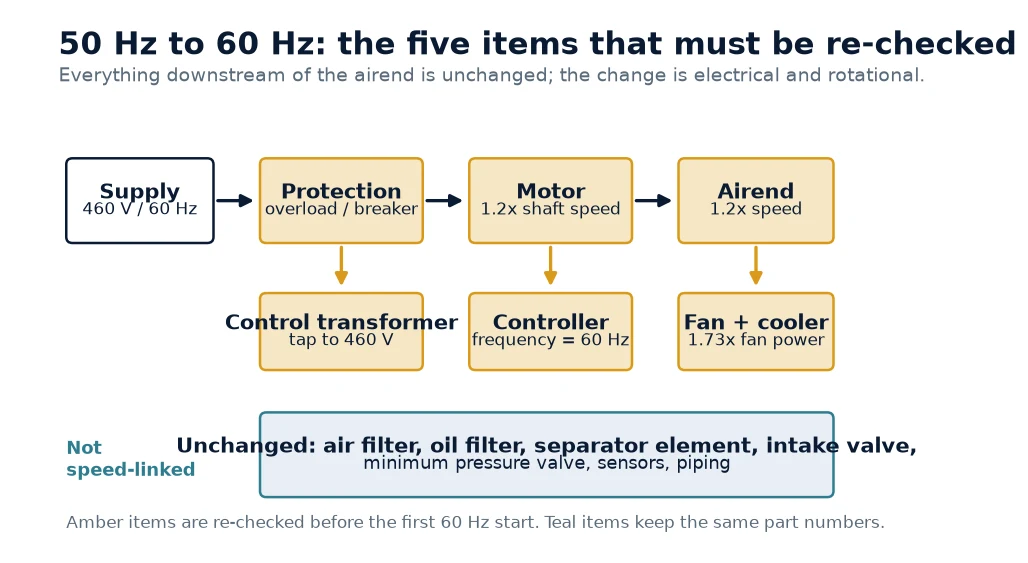
Short answer: at 60 Hz a direct-driven screw compressor turns about 20% faster, so air flow, heat rejection and shaft power all rise by roughly the same 20%, while discharge pressure stays wherever you set it. The valve, filter and separator parts do not change. What has to be proved before the first start is the rotating set and everything that protects it — motor rating at 460 V, overload and breaker settings, drive ratio on belt-driven units, fan duty, control-transformer taps and the frequency parameter in the controller.
This is the question behind most 60 Hz enquiries we receive: an imported machine or a build specified for a 50 Hz market is going into a 460 V / 60 Hz supply, and the buyer wants to know which spare parts change with it. The honest answer is that the change is electrical and rotational, not hydraulic. Below is the item-by-item list, in the order we would check it on a real unit.
What changes and what does not
The table below separates the two groups. Everything in the left column is speed-linked and must be verified; everything in the right column is pressure- or medium-linked and is unaffected by line frequency.
| Item | 50 Hz | 60 Hz | What to do |
|---|---|---|---|
| Motor full-load speed (2-pole) | ≈2,900 rpm | ≈3,500 rpm | Confirm the nameplate carries a 60 Hz rating |
| Airend speed, direct drive | Design speed | +20% | Check the airend’s maximum speed in its data sheet |
| Free air delivery | Design flow | +20% approx. | Re-check dryer, receiver and pipe sizing if the extra flow is used |
| Discharge pressure | Set point | Same set point | Nothing changes; the set point is a pressure, not a speed |
| Shaft power at the same pressure | Design kW | +20% approx. | Motor must be rated for it, not just survive it |
| Overload relay / breaker | Set to 50 Hz FLA | Set to 460 V FLA | Re-set from the 460 V nameplate current |
| Cooling fan | Design airflow | +20% airflow, +73% fan power | Check fan motor rating and tip speed |
| Cooler heat rejection | Design duty | +20% approx. | Watch oil temperature and approach at full load |
| Air filter, oil filter, separator, valves, sensors | — | Unchanged | Same part numbers, same service intervals |
| Controller frequency parameter | 50 Hz | 60 Hz | Set before running; read the motor rpm display afterwards |
The motor has to be proved first
Two things decide whether the existing motor can stay. First, the nameplate: a dual-rated motor shows both 50 Hz and 60 Hz columns with separate current values, and the 60 Hz column is the one that matters now. A motor stamped only for 400 V / 50 Hz is a single-frequency winding; running it at 60 Hz raises the shaft power demand by about a fifth at the same load torque, and whether that is acceptable is a question for the motor maker, not for a guess on the shop floor.
Second, the connection. A 400 V delta winding does not become a 460 V winding by moving links. If the terminal block offers a 460 V arrangement the links move; if it does not, the winding stays as it is and the voltage margin has to be confirmed. After any reconnection, bump the motor for two seconds and check rotation before the coupling goes back on — a reversed screw airend will run unloaded and quietly destroy its own lubrication within minutes.
Finally, the control circuit. Control transformers usually have taps for 400, 415 and 460 V, and solenoid coils, contactor coils and controller power supplies follow the tap. A machine moved to 460 V with the transformer left on the 400 V tap will run, but every coil on the machine is then 15% over its rated voltage — the kind of fault that shows up months later as a burnt coil, not as a failure at commissioning.
Airend speed: the 20% is not free
A direct-driven airend has no ratio to change, so its speed follows the motor. Twenty percent more speed means twenty percent more air and roughly twenty percent more shaft power, and the bearing life calculation goes with the cube of speed for the same load — which is why the airend’s maximum speed matters more than its rated flow at this point.
Two practical consequences show up within the first weeks. Oil carryover rises with speed, because the separator sees more oil mist per cubic metre of air; if the separator element is near the end of its life, differential pressure climbs faster than it did at 50 Hz, and oil reaches the downstream filter. Our guide to oil separator replacement intervals covers the differential-pressure criteria.
Discharge temperature also drifts up, because there is more heat to reject through the same cooler surface. If the unit starts tripping on high temperature after the move, work through the high discharge temperature check order before touching the thermostat.
Protection settings travel with the motor
The overload relay, the motor circuit breaker and any phase-failure relay are set for the current the motor draws at the old voltage. At 460 V the same shaft power draws less current than at 400 V, but the motor is also turning faster and delivering more power, so the 60 Hz full-load current from the nameplate is the only number worth setting to.
Three settings are routinely missed:
- Overload class. A class 10 relay is normal on a screw compressor; keeping a class 20 setting from a different build will let a jammed airend draw current far too long.
- Breaker frame versus trip. The frame may be large enough while the trip unit is still on the old setting.
- Controller motor data. If the controller calculates loading from current, its motor parameters (rated current, rated speed, service factor) must be edited, or it will unload early and report a false overload.
On machines with a variable-speed drive, the frequency limit, the motor data set and the drive’s own supply rating all need to be at 60 Hz. Our note on parts that cannot be swapped between VFD and fixed-speed machines explains why a drive-side change is never just a parameter edit.
Cooling: the fan obeys a different law
A centrifugal or axial fan driven at 60 Hz does not gain 20% of anything — it obeys the fan laws, and they are unforgiving:
| Quantity | Change at 60 Hz | Consequence |
|---|---|---|
| Fan airflow | ×1.20 | Better cooling, more noise |
| Fan static pressure | ×1.44 | Ductwork and grilles see more stress |
| Fan shaft power | ×1.73 | Fan motor must be rated for it |
| Blade tip speed | ×1.20 | Check the fan’s maximum rpm |
The cooler itself does not gain capacity. Air flow is up a fifth, so heat rejection is up a fifth through the same fins, and the approach temperature widens. On an air-cooled unit in a warm room the practical result is an oil temperature that sits 5–10 °C higher than it did at 50 Hz. Clean the cooler before the move so the comparison is honest, and confirm the thermostat element opens at the temperature stamped on it rather than one copied from another machine.
Pressure settings, the receiver and the safety valve
Pressure does not scale with frequency, which is the part people find surprising. The minimum pressure valve holds its set point, the loading and unloading band stays where it was, and the safety valve still opens at its stamped pressure. What does change is the volume of air moving through the system, so the receiver’s storage per unit of flow falls by a fifth and the compressor cycles more often under light load.
Two checks belong here. Confirm the safety valve setting is at or below the receiver’s design pressure — a valve re-stamped or swapped during the move is a pressure-vessel issue, not a maintenance detail. And confirm the minimum pressure valve still holds its set point after the rebuild; if the valve is being replaced at the same time, our comparison of MPV and combination valves covers which body style is which, and the minimum pressure valve range lists the port sizes and settings available.
Belt-driven units: the ratio is a part
If the motor drives the airend through belts, the 20% speed rise is not automatic — it arrives only if the pulley ratio is left alone, and that is usually the wrong outcome. On a belt-driven machine the correct move is to keep the airend at its design speed and let the motor’s higher speed be absorbed by a larger motor pulley. Two consequences follow: the pulley is a new part, and belt speed, belt length and alignment all change with it.
Pulley wear is the trap. A worn pulley groove lets the belt sit low, the effective diameter drops, and the airend runs slower than the calculation says. Before changing anything, measure the existing pulleys and check the coupling or belt alignment — the symptoms of a misaligned drive (whine, belt dust, vibration at one particular speed) are collected in our coupling selection and noise diagnosis guide.
Commissioning checklist for the first 60 Hz start
Work through this list in order. Each line is a five-minute check that prevents a week of downtime.
- Motor nameplate: 60 Hz rating and 460 V current recorded.
- Winding connection confirmed and control-transformer tap moved to 460 V.
- Overload relay, breaker trip and phase relay set to the 460 V figures.
- Rotation checked with the coupling open.
- Controller frequency and motor data at 60 Hz; displayed rpm matches a tachometer.
- Airend speed measured and compared with its maximum.
- Pulley ratio corrected on belt-driven units; belt tension and alignment set.
- Cooler cleaned; fan rotation and fan motor current checked.
- Safety valve stamp compared with the receiver design pressure.
- Two hours at full load: oil temperature, separator differential, discharge temperature and current logged against the 50 Hz baseline.
Frequently asked questions
Can a 50 Hz compressor run on a 60 Hz supply with no changes at all?
Only if the motor carries a 60 Hz rating, the airend is rated for the higher speed, and the protection settings are moved to the 460 V figures. Without those three, the machine will start and run — and then overload or overheat at full load.
Does free air delivery really go up by 20%?
Roughly, for a direct-driven machine at the same discharge pressure, because displacement scales with speed. The gain is only usable if the motor can deliver the extra shaft power and the airend is rated for the speed. Above the motor’s rating the machine simply cannot hold the pressure it used to.
Do I have to change filters, valves or the separator?
No. Those parts respond to pressure, temperature and contamination, none of which depend on line frequency. The same part numbers fit, though separator and oil filter life may shorten slightly because more air passes through them per hour.
What has to change on a VFD machine?
The maximum output frequency, the motor data set (current, speed, service factor) and the drive’s supply-voltage rating. A drive sized for 400 V cannot simply be re-parameterised for a 460 V supply; check its input rating first.
Will 460 V damage a motor wound for 400 V?
A dual-rated 400/460 V winding is designed for it. A single-voltage 400 V motor at 460 V runs with about 15% more volts per hertz, which means more flux, more magnetising current and more heat. Whether the insulation and thermal margin allow it is a question for the motor manufacturer.
These answers cover the common cases. Machine-specific limits always come from the manual of the unit in front of you.
Checking a machine that is moving to 60 Hz?
Send the nameplate details, the airend data and the existing protection settings. We will tell you which parts on the machine change with the frequency and which stay the same — and flag the ones that must be confirmed by the motor and airend makers.