
High Discharge Temperature on a Screw Compressor: What to Check, and in What Order
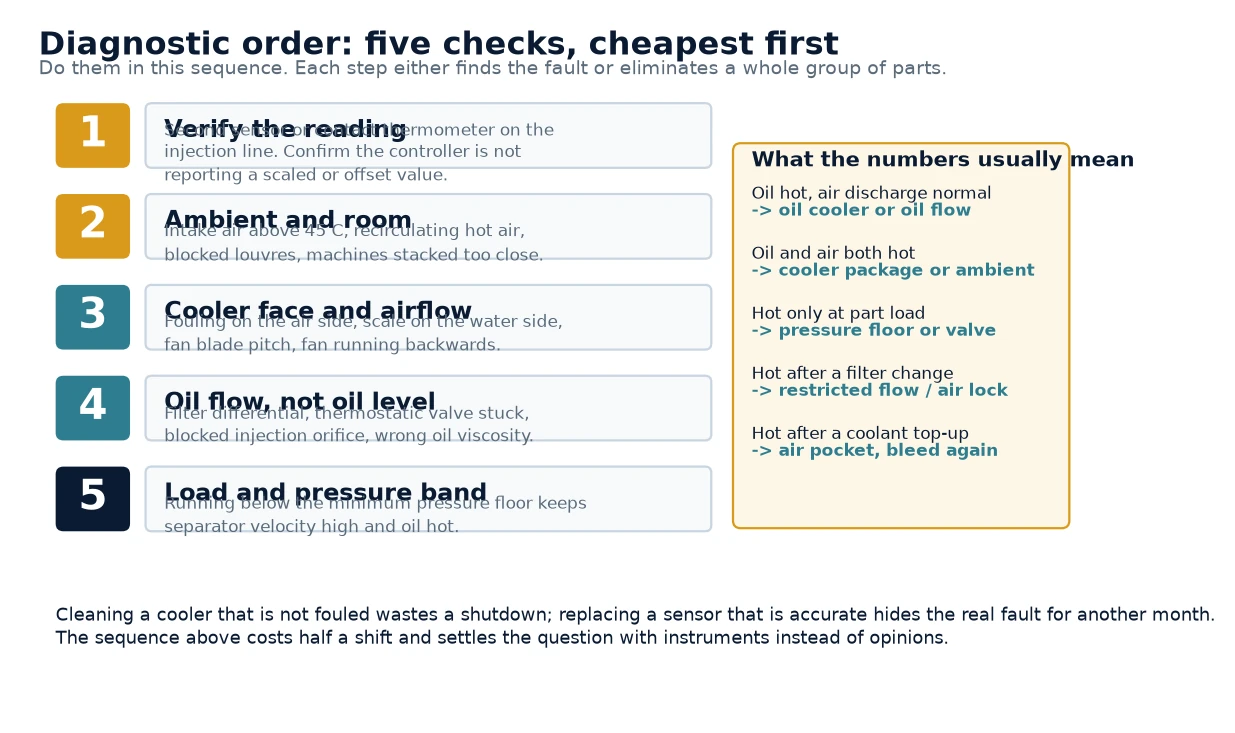
Short answer: on a lubricated screw compressor, high discharge temperature is almost never a sensor problem and almost always a heat-rejection or oil-flow problem. Diagnose it in a fixed order — confirm the reading, then the room, then the cooler, then oil flow, then the pressure band — and you will find the cause in half a shift instead of replacing a cooler that was never blocked.
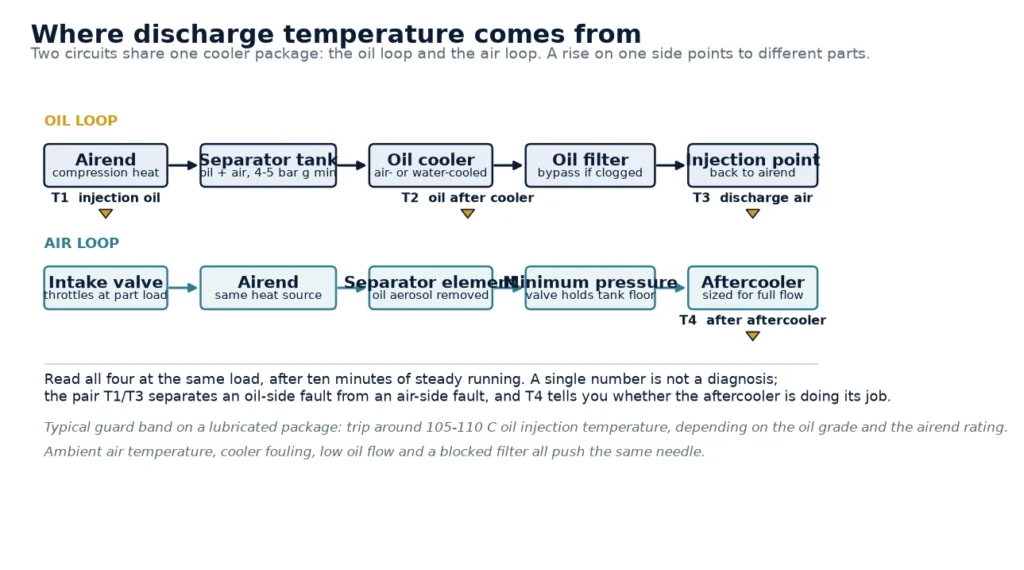
The reason a fixed order matters is that every cause produces the same number on the controller. A fouled radiator, a fan running backwards, an oil filter on bypass, a thermostatic valve stuck open, and a machine running at 3 bar instead of 7 bar all raise the injection oil temperature. The controller shows one value and one alarm. What separates them is where you measure and when the temperature rises, not how high it gets.
What the numbers should look like before you touch anything
Temperature limits are model-specific, but the relationships between the readings are not. Before diagnosing, get four readings at the same steady load and write them down: ambient air at the intake, injection oil temperature, discharge air temperature at the separator outlet, and air temperature after the aftercooler.
On a typical air-cooled lubricated package running in a 25–35 °C plant, the usual picture is:
| Reading | Typical healthy band | What a deviation points to |
|---|---|---|
| Ambient at intake | within 5 °C of room temperature | Recirculation, hot roof space, or a machine packed against a wall |
| Injection oil temperature | 70–95 °C at full load | Above this: heat rejection or oil flow; below: thermostatic valve stuck open |
| Discharge air at separator | 80–105 °C | Tracks oil temperature; a wide gap between the two is unusual and worth a second look |
| Air after aftercooler | ambient + 10–15 °C | Approach wider than this: aftercooler fouling or undersized for the duty |
| Oil temperature at part load | should not climb | Climbing at part load points to pressure floor or valve, not to the cooler |
Two rules save time. The trip point is not the diagnosis — a machine tripping at 105 °C has been running hot for weeks, so the trend on your service sheet says more than the alarm. And if oil and air temperature move together, the fault is upstream of the separator: cooling or oil flow.
Check one: verify the reading before you believe it
Sensor drift is real but it is not the common cause, and it is cheap to eliminate. Put a contact thermometer on the metal of the injection line within 100 mm of the sensor pocket, or read the same circuit with a second instrument through the controller’s service menu.
If the two readings agree within 2–3 °C, the sensor is telling the truth and you move on. If they disagree by more than that, the sensor, its cable run, or the controller’s scaling is at fault — and you should still check the physical cooling system, because a machine that has been quietly ignored for a month usually has two problems, not one.
One trap worth naming: a replaced sensor with the wrong range or pocket depth reads with a constant offset — look there, not at the cooler.
Check two: the room, not the machine
A compressor rejects roughly all of its shaft power as heat. A 37 kW unit releases something in the order of 30 kW of heat into the room, and if that room cannot lose it, the machine heats its own intake air and the discharge temperature climbs until it trips.
The symptoms are consistent: temperature rises through the day rather than at start-up, and falls overnight or when a door is opened. Look for:
- hot air from the cooler outlet discharging back into the intake side, or into a corner that feeds the intake;
- machines installed back to back with less than the manual’s clearance, so the fan pulls air it has just rejected;
- louvres, grilles or roof vents blocked by dust, bird mesh or a later partition wall;
- a ducted exhaust that was sized for one machine and now serves three;
A quick test that costs nothing: measure the intake air temperature, not the room temperature. If intake air is more than 5 °C above the room, the machine is breathing its own exhaust and no amount of cooler cleaning will fix it.
Check three: the cooler itself, air side then water side
Only after the first two checks should the cooler come apart — and the cleaning method depends on which side is fouled.
Air side. Dust, lint and oil mist combine into a felt-like layer that blocks airflow almost completely. Blow through from the clean side, backwards against normal flow, with the fan isolated, and never with a high-pressure jet straight into the fins — that folds them flat and permanently reduces the surface.
Water side. Scale and biological film. A shell-and-tube cooler with a 3 mm scale layer can lose a third of its duty. Circulate a suitable descaler at the concentration the cooler maker specifies, flush thoroughly, and check the water flow and outlet temperature afterwards. On a plate cooler, back-flush before considering chemicals; plates block in the narrow gap far more often than they scale.
| After cleaning, measure | Pass criterion | If it fails |
|---|---|---|
| Oil temperature at full load | back within 5 °C of the commissioning value | Cooler still restricted, or the fault was never the cooler |
| Air-side differential across the cooler | close to the clean-fins figure in the manual | Fins flattened or a bypass path around the core |
| Water outlet temperature (water-cooled) | within the design rise | Water flow too low: valve, strainer or pump |
| Fan current | within nameplate, no oscillation | Blade pitch, bearing, or a wrong rotation direction |
| Temperature after 30 minutes at full load | stable, not still climbing | Re-check oil flow; a restricted filter behaves like a fouled cooler |
If you clean the cooler and the temperature returns to normal for two weeks and then climbs again, the fouling is being caused by something else: oil mist from a saturated separator element, or dust from a missing intake filter gasket. Fix the source or you will be cleaning it again next month.
Check four: oil flow, which is not the same as oil level
A correct oil level with poor oil flow is one of the most common causes of high temperature, and the least often diagnosed. The oil carries heat out of the airend; if the flow is restricted, the injection temperature rises even though the cooler is clean and the tank is full.
- Oil filter on bypass. Most filters have a bypass valve that opens when differential pressure gets high. Flow continues, filtration stops, and the restriction itself adds heat. Measure differential if the machine has gauges; if it does not, change the filter and see whether the temperature drops.
- Thermostatic (temperature control) valve. This valve should send oil through the cooler once it is warm. Stuck in the bypass position, oil never reaches the cooler and temperature climbs steadily with load. Feel both sides of the cooler: if the cooler stays cold while the machine is hot, the valve is the fault.
- Injection orifice or nozzle. A blocked or partly blocked nozzle starves the airend of oil. Temperature rises fast, and on some machines you can hear the change in tone.
- Wrong oil viscosity. Oil too thick for the ambient does not flow at start-up; oil too thin loses film strength at temperature. Use the grade the manual specifies for the ambient range.
Oil condition belongs here too. Oxidised, thickened oil flows worse and holds heat. If the oil in the sight glass is dark and opaque, sample it before chasing the cooling system any further.
Check five: the pressure band the machine is actually running in
Compression ratio is set by the pressure the machine works against, and temperature follows the ratio. A machine asked to hold 4 bar at low demand runs a lower ratio, but separator velocity rises and oil carryover climbs, which loads the element and pushes temperature back up.
The opposite case is more obvious: a machine set to 10 bar while the plant only needs 6 bar runs at a higher ratio than the application requires, and runs hotter for no benefit. Check the set point, the unload pressure, and whether the minimum pressure valve is holding the floor it is supposed to.
Check the load pattern too. A machine cycling load and unload every 40 seconds never reaches thermal steady state; if the controller log shows a very short cycle, the receiver is too small for the demand profile.
Reading the pattern instead of the alarm
By the time you have worked through the five checks you usually have a pattern as well as a number. Use it:
| Pattern | Most likely cause | Next step |
|---|---|---|
| Hot at start-up, normal after ten minutes | Cold oil too thick to flow, or a thermostat valve late to open | Check oil grade for ambient; test the thermostatic valve |
| Rises slowly through the shift | Room heat build-up or recirculation | Measure intake air, fix ventilation |
| Hot only at full load | Cooler duty or oil flow | Clean cooler, check filter differential |
| Hot only at part load | Pressure floor, minimum pressure valve, separator loading | Check tank pressure at minimum demand |
| Hot immediately after a service | Air lock, wrong oil, filter fitted backwards | Bleed, verify grade and filter orientation |
| Hot and noisy, capacity down | Injection nozzle restriction or airend wear | Measure flow and current against commission data |
Related reading: the symptom-to-cause map for screw compressors puts temperature alongside pressure, oil consumption and noise symptoms; replacement intervals and rejection criteria covers the filters that most often sit behind a temperature complaint; and the difference between variable-speed and fixed-speed parts matters when the machine is inverter-driven, because the cooling fan and the pressure floor behave differently at low speed.
When to replace instead of clean
Cleaning is the right first move on a fouled core. Replacement is the right move when the core is damaged rather than dirty:
- fins crushed or folded over a significant part of the face, so airflow is reduced even when clean;
- a leak that shows as oil film or a pressure test failure on the oil side of the cooler;
- internal corrosion or a tube that has been plugged and re-plugged more than once — the duty is gone even if it holds pressure;
- a core that has been cleaned properly and still cannot hold the commissioning temperature at rated ambient;
- a cooler that has been replaced with the wrong core, which happens after an emergency repair: same footprint, different fin density, wrong duty.
Before ordering, confirm three things: the flow direction on the oil side, the connection sizes and orientation, and whether the fan and core are sold as a matched assembly. A core that is dimensionally identical but has a different fin count will run either hot or cold, and neither will be obvious until the machine is back in service.
If you are unsure whether the fault is the cooler or the oil circuit, send us the model, the four temperature readings and the load at which they were taken, and we will tell you which parts to check first.
Frequently asked questions
Is high discharge temperature dangerous if the machine has not tripped yet?
It shortens oil life and bearing life long before it trips. Oil oxidises faster above roughly 95 C, and varnish forms on the airend and in the cooler, which reduces cooling further. A machine running 10 C above its commissioning value is already damaging itself, even if the alarm never sounds.
Can I just turn up the trip point?
No. Raising the trip point removes the only protection the airend has and converts a cooling fault into a bearing failure. If the machine genuinely needs a higher limit for a hot climate, that is a change to be made with the manufacturer’s written approval and a matching oil specification, not a parameter edit.
Why does the temperature drop when I open the compressor room door?
Because the machine is recirculating its own hot exhaust. The intake is pulling air that has already passed through the cooler. Fix the airflow path so the hot discharge leaves the room and the intake draws from outside that stream; cleaning the cooler will not change this pattern.
The cooler is clean and the oil filter is new. What is left?
The thermostatic valve, the injection nozzle, the oil grade, the pressure band, and the separator element. Feel the cooler: cold cooler with a hot machine means oil is bypassing it. Then check tank pressure at minimum demand, because a machine running below its minimum pressure floor loads the separator and runs hot.
How often should a cooler be cleaned?
On condition, not on a calendar. Inspect the air side every 2,000 hours or whenever the ambient season changes, and clean when the differential across the core has risen meaningfully from the clean-fins figure. In dusty plants that can be every few months; in a clean plant a year may pass with nothing but a blow-down.
Does a variable-speed machine run hotter at low speed?
It can. At low speed the fan may turn more slowly as well, and the oil pump delivers less flow. Machines designed for variable speed use an independent or electrically driven fan for exactly this reason. If a converted machine runs hot only at low load, the cooling fan is the first thing to look at.
These answers cover the common cases. Machine-specific limits always come from the manual of the unit in front of you.
Send the four readings and the model
Tell us the model, the ambient temperature, the injection oil temperature and the load at which you measured it — we will tell you which parts to check before you take the cooler apart.