
Air, Oil and Separator Filters: Replacement Intervals and Rejection Criteria
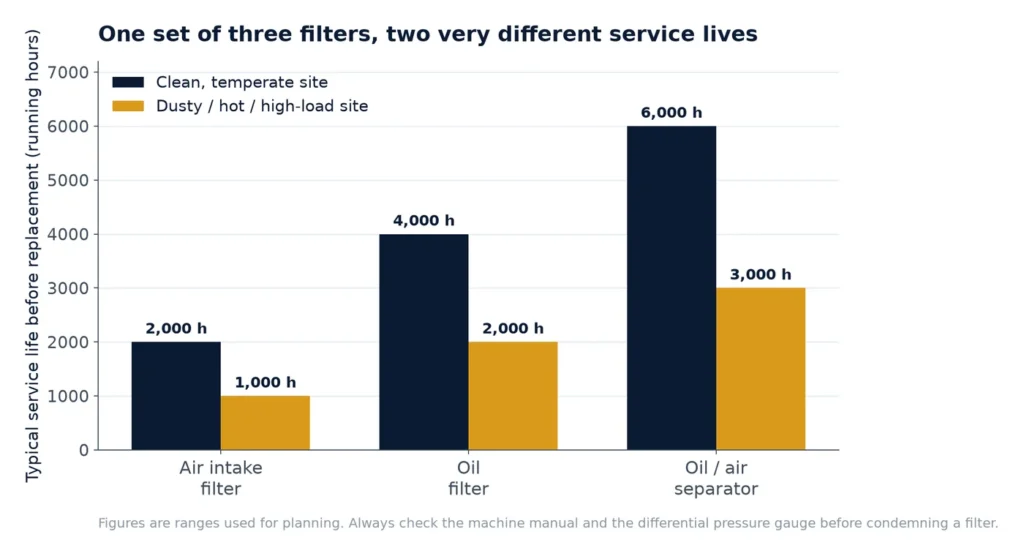
Short answer: on a lubricated screw compressor in a clean, temperate plant, plan on an air intake filter every 2,000 running hours, an oil filter with every oil change (typically 4,000 hours), and an oil separator element somewhere between 4,000 and 8,000 hours. On a dusty site, in a hot climate, or on a machine that sits at full load all day, cut those numbers by 30 to 50 percent — and then let the differential pressure gauge, not the calendar, make the final decision.
That is the planning answer. The harder question, the one that actually costs money in the field, is this: when the gauge is in the yellow zone at 1,800 hours, is the element genuinely finished, or is it a dirty pre-filter, a stuck bypass valve, or a clogged oil return line? This guide sets out the intervals, the correction factors that shift them, and the rejection criteria we use to condemn a filter element with evidence instead of guesswork.
What each of the three filters actually protects
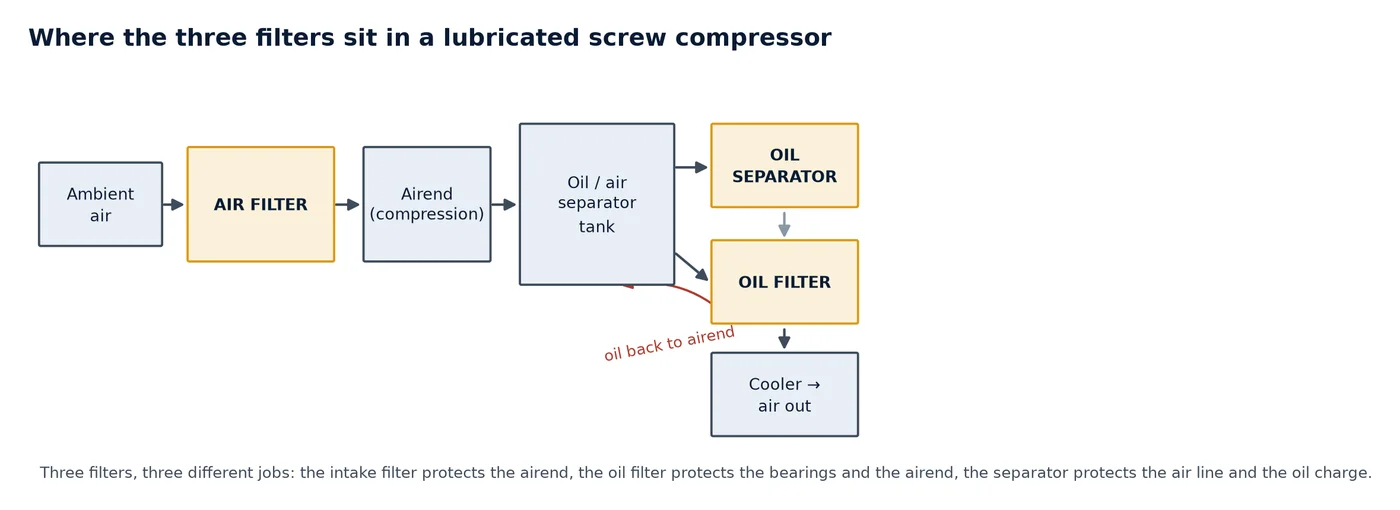
The three elements are often treated as one consumable set because they are usually changed together. They are not interchangeable in function, and they fail for completely different reasons. Getting this straight is the difference between a service plan and a parts order.
| Element | What it removes | What it protects | Typical end of life |
|---|---|---|---|
| Air intake filter | Dust, pollen, workshop grit, 5–10 micron and up | Rotor and casing, oil charge, separator element | Loading up with dust; restriction rises, capacity falls |
| Oil filter | Metal particles, varnish, carbon, sludge from thermal ageing | Bearings, shaft seal, airend internals | Media loaded or bypass valve open; oil goes unfiltered |
| Oil separator | Oil aerosol carried out of the separator tank (down to 1–3 ppm on a healthy element) | The compressed air line, dryers, filters and the oil charge itself | Saturated or collapsed; oil carryover climbs, then pressure drop climbs |
Note the direction of failure. A loaded air filter costs you capacity. A loaded oil filter costs you bearing life. A saturated separator costs you oil, and oil is the most expensive thing that quietly leaves a compressor room.
Baseline intervals: hours first, calendar second
Service clocks on screw compressors count running hours, not loaded hours and not ambient severity. That single fact explains most premature failures: two machines can show 2,000 hours on the controller while one has moved twice the air of the other. Use the table below as a starting point and correct it with the factors in the next section.
| Element | Clean / temperate site | Dusty, hot or continuous full load | Calendar backstop |
|---|---|---|---|
| Air intake filter | 2,000 h | 1,000 h (500 h in foundry or cement dust) | 12 months |
| Oil filter | 4,000 h, with the oil change | 2,000 h | 12 months |
| Oil separator element | 6,000–8,000 h | 3,000–4,000 h | 12–24 months |
The calendar backstop matters more than most maintenance plans admit. Oil oxidises, media absorbs moisture, and rubber seals take a set whether the machine runs or not. A standby compressor that logs 400 hours a year still needs its oil filter replaced on time, because the contaminant load it accumulates is dominated by condensation and start-stop cycling, not by running hours.
The four correction factors that move the interval
Instead of arguing about whether 2,000 hours is right, apply four multipliers to the baseline and write the result on the machine. This is also the fastest way to explain to a customer why their interval differs from the manual.
| Factor | Condition | Effect on air filter | Effect on oil filter and separator |
|---|---|---|---|
| Dust load | Machining, sandblasting, textile, cement | Halve it; add a pre-filter or relocate the intake | Reduce 20–30%; more solids reach the oil |
| Ambient temperature | Above 35 °C sustained, or a hot plant roof | Little direct effect | Reduce 20%; oil oxidation and varnish accelerate |
| Duty cycle | Above 80% load for most of the day | Reduce 20%; higher air volume per hour | Reduce 20–30%; more oil aerosol through the separator |
| Start-stop cycling | Frequent starts, short shifts, standby duty | Little direct effect | Reduce 20%; condensation and acid build-up dominate |
Two of those factors push in opposite directions, which is exactly why an hours-only schedule drifts. A standby machine on a clean site may reach 12 months with 500 hours and a wet oil charge; a foundry machine may reach 500 hours with a filter that looks like a felt mat. Both are overdue by a criterion the hour meter cannot see.
Rejection criteria: three tests before you condemn an element
A filter is rejected when there is evidence, not when it looks dark. Dark media on an air filter is normal and often means it is working. Use these tests in order; the first one that fails is enough.
Air intake filter
- Restriction gauge: most intake housings carry a mechanical indicator that latches in the red when restriction passes the service point (commonly 6–10 kPa depending on the element). If it has latched, replace; do not reset and continue.
- Visual and light test: hold the element against a lamp. Pinholes, splits at the end cap, a collapsed pleat pack, or dust tracked past the sealing lip all mean replacement even at low hours.
- Seal check: a hard, flattened or torn gasket is a rejection on its own — unfiltered air bypassing the seal does more damage than a dirty element ever will.
Oil filter
- Differential pressure: a rise of roughly 1 bar above the clean baseline at operating temperature means the media is loaded. If the housing is cold to the touch on one side and hot on the other, the bypass valve is open and the bearings are running on unfiltered oil.
- Oil analysis: iron and aluminium counts climbing between samples, with no mechanical fault found, point at filtration rather than at wear.
- Physical inspection: cut a used element open. Sludge, metallic paste on the pleats, or a collapsed centre tube are all rejections; a uniformly grey element is not.
Oil separator element
- Oil carryover: visible mist at the aftercooler drain, oil in the condensate, or a rising oil consumption with no external leak. That is the separator talking.
- Pressure drop across the tank: compare tank pressure with line pressure at full load. A growing gap means a loaded element.
- Foam in the sight glass: persistent foam after the oil has warmed up indicates a saturated separator returning oil poorly, or a blocked return orifice. Check the orifice before blaming the element.
One warning before you order anything: a separator that fails at 1,200 hours is usually a symptom, not a bad batch. Overfilling, the wrong oil viscosity, a blocked scavenge line, or a failed minimum pressure valve will destroy a new element in the same number of hours. Fix the cause, or you will be back in three months with the same complaint.
Reading the differential pressure gauge properly
Most arguments about filter condition come from reading the gauge at the wrong moment. Three rules make it reliable:
- Read at full load and at operating temperature. A restriction reading taken at idle is meaningless, because flow is low and the pressure drop with it.
- Establish a clean baseline. Write the reading on the housing when the element is new. Every later reading is compared to that number, not to a catalogue value.
- Trust the trend, not the absolute number. A filter that has moved from 0.2 to 0.6 bar in 800 hours is finished for planning purposes, even if the red zone starts at 1.0 bar.
For machines without a gauge, a simple 0–1 bar differential instrument teed across the filter housing pays for itself the first time it prevents an unnecessary element change — or catches a collapsed one. Our oil filter elements and oil separator elements are built to take that measurement without the housing cracking at the port.
Symptom to filter: a diagnosis table
When a machine arrives with a complaint rather than a service request, work backwards from the symptom. This table covers the cases we see most often on distributor service desks.
| Symptom | Most likely filter cause | Confirm with | Do not overlook |
|---|---|---|---|
| Delivery drops, motor current falls | Air intake restriction | Restriction indicator, compare with clean baseline | Blocked intake duct or closed louvre |
| High discharge temperature | Loaded oil filter, bypass open, oil flow low | Differential pressure across the oil filter | Cooler fouling, low oil level, thermostat |
| Oil in the air line and dryers | Separator saturated or collapsed | Carryover test, tank to line pressure gap | Blocked scavenge orifice, overfill, wrong oil |
| Oil consumption rises with no leak | Separator past end of life | Weigh top-up against running hours | Leaking shaft seal evaporating quietly |
| Media found collapsed or burst | Water ingress or wrong element fitted | Check housing drain, part number, seal fit | Separator element installed upside down |
| Fine dust downstream of the intake | Sealing lip not seated, housing distorted | Wipe test inside the intake pipe | Cracked intake hose after the filter |
What a distributor should keep on the shelf
Filter stock is a service promise. If the element is not on the shelf, the customer’s machine runs another 500 hours on a saturated separator and the next conversation is about oil consumption, not about filters. A workable minimum for a service operation covering mixed 15–75 kW machines:
- Air filters in the two or three housing sizes that cover most of the installed base, not one of every variant.
- Oil filters matched to the same engine families, plus the small-element versions used on compact machines.
- Separator elements in the two or three common tank diameters — these are the slowest to arrive and the most damaging to run past their life.
- Seal kits and scavenge orifice filters. They cost almost nothing to hold and prevent most repeat separator failures.
- A differential pressure gauge and a clean-baseline label for every service van.
For the intake side, our air filter elements are available across the common housing sizes, and the engineering behind the pleat pack is covered in this breakdown of air filter construction. If the machine also runs downstream filtration, the element grading logic in precision filters explained will save you from over-specifying coalescers to compensate for a tired separator.
Frequently asked questions
Can I clean an air filter instead of replacing it?
For a dry pleated paper element, low-pressure air from the clean side can extend life in an emergency, but it does not restore the media and it often damages the pleats. On a machine that matters, replace it. Washable pre-filters are the exception, and they are designed for it.
Why did my separator element fail at 1,200 hours?
Almost always one of four causes: the oil charge is above the maximum level, the scavenge line or orifice is blocked, the wrong oil viscosity is in the machine, or the minimum pressure valve is not holding, so the element sees reverse flow at shutdown. Replace the element only after one of those is checked.
Is a 4,000-hour oil filter interval safe on a machine that runs 24 hours a day?
Only if the oil analysis supports it. Continuous duty at high load ages oil faster and loads the filter faster. On 24/7 operation we normally see 2,000 to 3,000 hours with oil sampling at every second change.
Do I need the same brand of filter as the compressor?
The filter must match the housing, the sealing geometry and the flow rating of the machine. Inside those limits, a correctly specified equivalent element performs the same job. What does not work is a physically similar element with the wrong media area or a soft seal, and that failure mode is expensive.
These answers cover the common cases on lubricated screw compressors. Machine-specific limits always come from the manual of the unit in front of you.
Setting up a filter programme for a fleet?
Tell us the machine models, the site conditions and how many units you service. We will come back with the element list, the recommended interval per site type and the rejection tests your technicians can run on site.