
Air Filter Element Cross-Reference: How to Match a Compressor Element Without a Part Number
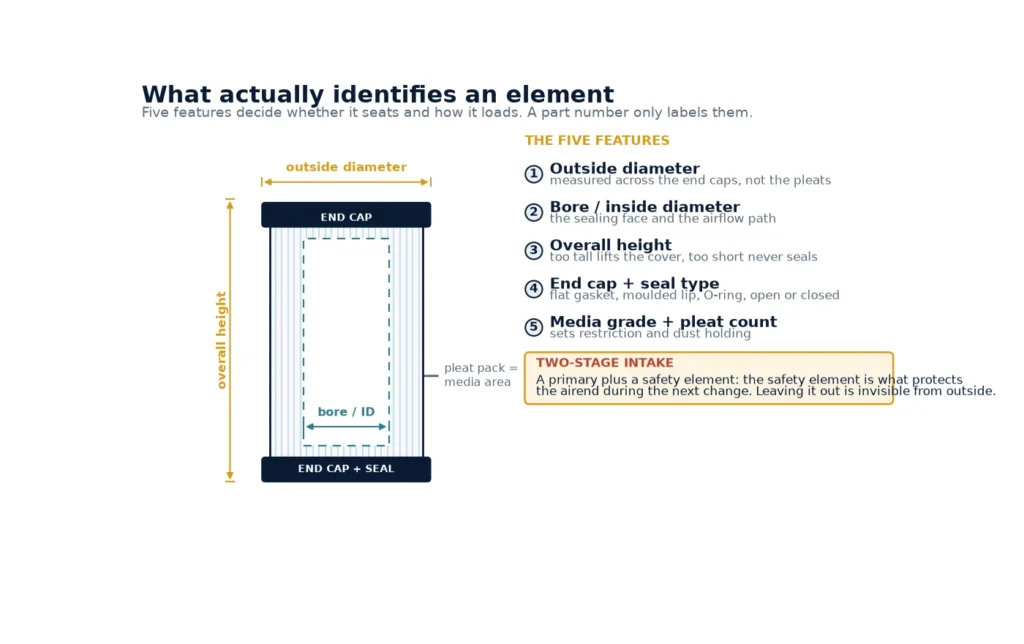
Short answer: a filter cross-reference is a dimensional match, not a lookup table. An element is identified by five things — outside diameter, inside diameter or bore, overall height, end-cap and seal arrangement, and media grade. A part number is only a label someone else once attached to that same set of features. If you start from a number and stop there, you will eventually fit an element that seats badly, filters less area, or collapses into the housing. If you start from the five features, you can identify an element from a machine with no readable plate, no manual and no parts list — which is the normal situation for imported compressors after a few years in service.
This guide is the procedure we use when a customer sends a photo of an element and one dimension: what to measure, what the old element is telling you, which near-matches are safe, and how to check the fit after installation instead of hoping.
Why part numbers cross-reference badly
A number is a local identifier. It belongs to whoever issued it — a compressor builder, a filter maker, a distributor’s catalogue — and it identifies a part in that catalogue, not a physical object in your housing. The same element routinely carries four or five numbers depending on who is selling it, and a builder’s number for a 2011 model often maps to a superseded element with different end caps.
The second problem is that search results rank by text similarity, not by fitment. Typing a number into a search engine returns a page of "equivalents" whose titles repeat your number and whose dimensions differ by ten millimetres. That is how people end up with an element that is 20 mm too tall, seals on the wrong face, and lets dust past the seal lip for a year before anyone notices the compressor is breathing dirty air.
| What people assume a number gives them | Reality | What to do instead |
|---|---|---|
| One number, one element | One element, several numbers — and one number reused for different heights | Confirm the five features before ordering |
| Same number means same brand | Numbers get copied by aftermarket makers; media grade and pleat count change | Compare media area and end caps, not labels |
| The manual number is current | Supersessions are normal, especially on 10-year-old machines | Check the dimensions of the superseded item |
| A cross-reference chart settles it | Charts are compiled from catalogues, and catalogues contain errors | Treat a chart as a shortlist, measure to confirm |
The five features that identify an element
Measure the old element with a vernier or a tape that reads to a millimetre, not with a ruler held at arm’s length. All five features matter, but they matter in this order: if the bore and the seal do not match, nothing else rescues the fit.
| Feature | How to measure it | Why it decides the fit |
|---|---|---|
| Outside diameter | Across the metal end caps, not across the pleats | Sets radial clearance in the housing; pleats compress, end caps do not |
| Inside diameter / bore | Across the outlet opening, or the thread if it is a spin-on | The sealing face and the airflow path at the same time |
| Overall height | End cap to end cap, element relaxed and upright | Too tall lifts the cover off its seal; too short never seats |
| End cap and seal arrangement | Photograph both ends: flat gasket, moulded lip, O-ring groove, open or closed end | Decides whether unfiltered air bypasses the media |
| Media grade and area | Pleat count, pleat depth, outer wrap, inner support mesh | Sets restriction and dust holding at the same face velocity |
A sixth feature matters on two-stage intakes: whether the housing carries a safety element behind the primary. If it does, the primary’s inner end is open and the safety element is what actually protects the airend during a primary change. Replacing a two-stage set with a single element leaves that protection out, and nothing on the outside of the machine shows it.
Read the old element before you bin it
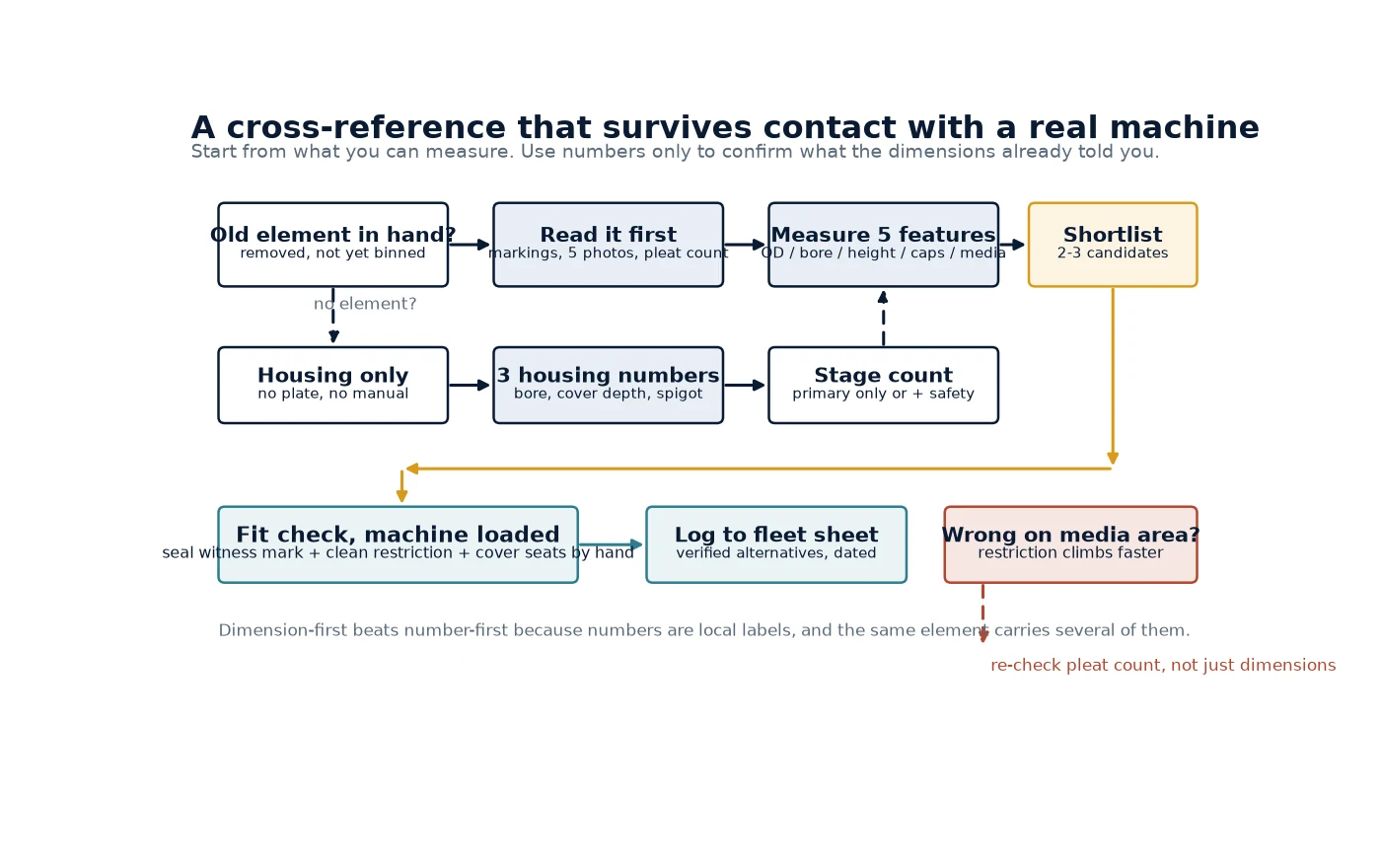
The element you are replacing is the best documentation you have, and it is usually thrown away within ten minutes of removal. Before that happens, record:
- Both end caps photographed square-on, with a ruler laid across each one.
- Any printing on the end cap or the outer wrap: builder mark, number, batch, airflow arrow.
- The pleat count on one half of the circumference — double it and you have the pleat count, which is the quickest proxy for media area.
- The condition pattern: dust concentrated on one side means the seal was leaking on the other; a collapsed or torn pleat pack means water or over-pressure, not just dirt.
- The colour of the inner (clean) side. If it is grey, the element was bypassing and the problem is the seal or the housing, not the filter.
Those five observations cost two minutes and settle most arguments about what the machine originally had. They also tell you whether the failure you are fixing is "wrong element" or "right element, wrong installation" — two problems with the same symptom and completely different fixes.
Narrowing by machine instead of by number
When the plate is unreadable, work from the machine inward. Compressor families share intake housings across a power band, so identifying the family narrows the element to a handful of candidates before you measure anything. The housing is the binding constraint: bolt pattern, cover depth and inlet spigot diameter are far harder to change than the element itself.
| What you can establish | What it eliminates | What is left to measure |
|---|---|---|
| Power band and drive type (direct or belt) | Most cross-family candidates | Two or three element sizes |
| Housing bolt pattern and cover depth | Any element taller than the cover allows | Height and end-cap style |
| Inlet spigot diameter | Elements with a smaller bore and no adapter | Bore and seal face |
| Number of stages in the housing | Single-element candidates in a two-stage intake | Primary and safety element separately |
If you have none of the above — a machine from a builder that no longer exists, with no plate and no manual — the housing dimensions alone are still enough. Measure the housing’s internal bore, the depth from the sealing face to the cover, and the diameter of the outlet spigot. Those three numbers, plus a photo of the cover, are what a parts supplier actually needs.
Five traps that break a dimensional match
Most wrong elements are not obviously wrong. They fit, they run, and they fail slowly. These are the five near-matches that pass a casual check:
| Trap | How it looks fine | What actually happens |
|---|---|---|
| Same diameter, different height | Drops into the housing | Cover does not compress the seal; dust enters past the end cap |
| Open end where the original was closed | Same length and bore | Air bypasses the media through the open end |
| Separate O-ring instead of a moulded lip | Seals when new | O-ring rolls or hardens; leak appears after a few hundred hours |
| Same dimensions, half the pleat count | Fits perfectly | Higher restriction, earlier loading, shorter service life |
| Safety element left out | Primary fits and looks complete | No protection during the next element change; dirt reaches the airend |
Fit check after installation
A fit check is five minutes and it is the only step that tells you the cross-reference was correct. Do it with the machine running at steady load, not at start-up:
- Seal witness mark. Before closing the cover, put a thin smear of chalk or grease on the seal face. After ten minutes of running, open it: the mark must be continuous all the way round. A gap means the element is short or the seal is wrong.
- Restriction reading. Note the intake restriction at full load on a clean element and write it on the housing. Compare it with the manual’s clean-element figure; a much higher number means the media is too dense or the pleat area too small.
- Cover seating. The cover must sit metal to metal, or on its stop, with hand pressure — if it needs force, the element is too tall.
- Leak check at the joints. With the machine loaded, run a hand around the intake joints; a whistle or a draught is unfiltered air going straight in.
Then log the restriction again after 500 hours. If it has climbed faster than the previous element did, the cross-reference was wrong on media area even though it was right on dimensions.
A fleet cross-reference sheet that stays correct
If you maintain more than a handful of machines, the cross-reference belongs in a sheet you control, not in a supplier’s catalogue. One row per machine, updated whenever an element is changed, and every alternative number marked as verified or unverified. Keep the verified ones only: an unverified alternative is a future breakdown waiting for a busy week.
| Column | What goes in it | Why it earns its place |
|---|---|---|
| Machine and serial | Builder, model, serial, kW | Ties the row to a physical unit |
| Housing | Bolt pattern, bore, cover depth | Lets you match a new element without the old one |
| Current element | Number as printed, plus brand | Baseline for the next comparison |
| Dimensions | OD / bore / height in millimetres | The actual match criteria |
| Seal and stage | End-cap type, single or two-stage | The two features people forget |
| Alternatives | Numbers verified against dimensions, dated | Prevents re-verifying the same match every year |
When to stop cross-referencing and just measure
The honest limit of cross-referencing is this: it works when you have the old element or the housing, and it stops working when you have neither. In that case, do not buy from a chart — send three dimensions, two photos and the machine plate if there is one. Any supplier who answers a dimensioned enquiry with a number and no questions is guessing on your behalf.
The same discipline applies to the other two filters in the service set. The oil filter and the separator element are matched the same way, but with one extra rule: on the separator, the pressure-drop specification is part of the fit, not an afterthought. You can read the rejection criteria for all three in our guide to air, oil and separator filter replacement intervals, and the element range itself under air filter elements, oil filters and oil-gas separator elements.
Frequently asked questions
Can I use an element with identical dimensions but different media?
Sometimes, but treat it as a different part. Identical dimensions with denser media raise restriction and shift the loading curve; identical dimensions with half the pleat count shorten service life. Check the clean restriction after fitting, then compare the rise over 500 hours against the element you replaced. If you cannot measure restriction, stay with the construction you had.
How much height difference is acceptable?
On a housing with a compressible seal, one or two millimetres can still seat. On a housing that seals on a moulded lip against a fixed shoulder, there is no allowance at all. The test is not the number, it is the witness mark: a continuous seal imprint after running means it seated, and a gap means it did not, however small the dimensional difference looked.
Is a taller element always better?
No. Height adds media area only if the housing can take it without lifting the cover off its seal. An element that is too tall is worse than a correctly sized one, because the bypass it creates lets unfiltered air through continuously, and no restriction reading will show that as a fault.
Can a paper element be washed and reused?
Blowing out with air from the clean side is acceptable as an emergency measure on some elements, at reduced pressure and from the inside out. Washing is not: water drives dust into the media, and the pleat pack rarely dries evenly enough to avoid a restriction rise. Elements intended for washing are built differently and are marked as such.
What if I only know the housing dimensions?
That is usually enough. Give the internal bore of the housing, the depth from the sealing face to the cover stop, the outlet spigot diameter, and whether the housing takes one element or a primary plus a safety element. Add a photo of the cover and one of the housing mouth. Those inputs identify an element far more reliably than any part number copied from a manual.
Why did the replacement element load up faster than the original?
Three usual causes, in order: less media area in the replacement (fewer or shallower pleats), a seal that is bypassing and letting a dust-laden stream onto the clean side, or an intake leak downstream of the filter that pulls dirty air in after the element. Compare pleat counts first, then check the seal witness mark, then look for a split hose or a loose clamp.
These answers cover the common cases. Machine-specific limits always come from the manual of the unit in front of you.
Send the dimensions, not the number
Photograph both end caps with a ruler in frame, note the outside diameter, bore and height in millimetres, and tell us how many stages the housing has. We will match the element against those dimensions and tell you if the number you have does not belong to that housing.