
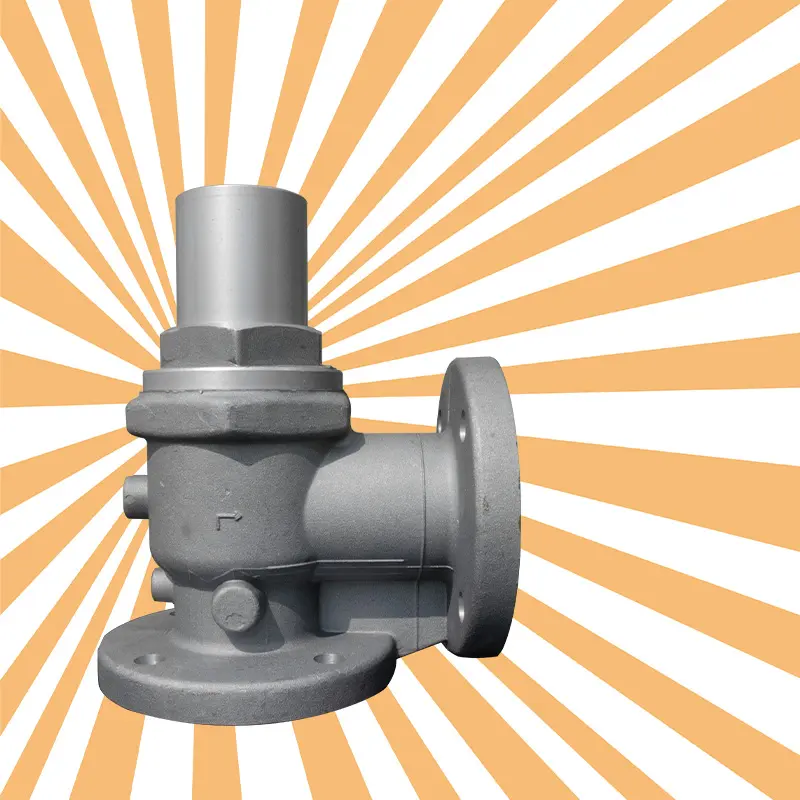
Two valves on the discharge side of a screw compressor are constantly confused: the minimum pressure valve (MPV) and the combination valve (CTV — combined valve). They sit in the same part of the machine, they look similar from the outside, and on many machines they perform overlapping jobs. This guide explains what each one does, how to tell them apart in the field, and what changes when you replace one with the other.
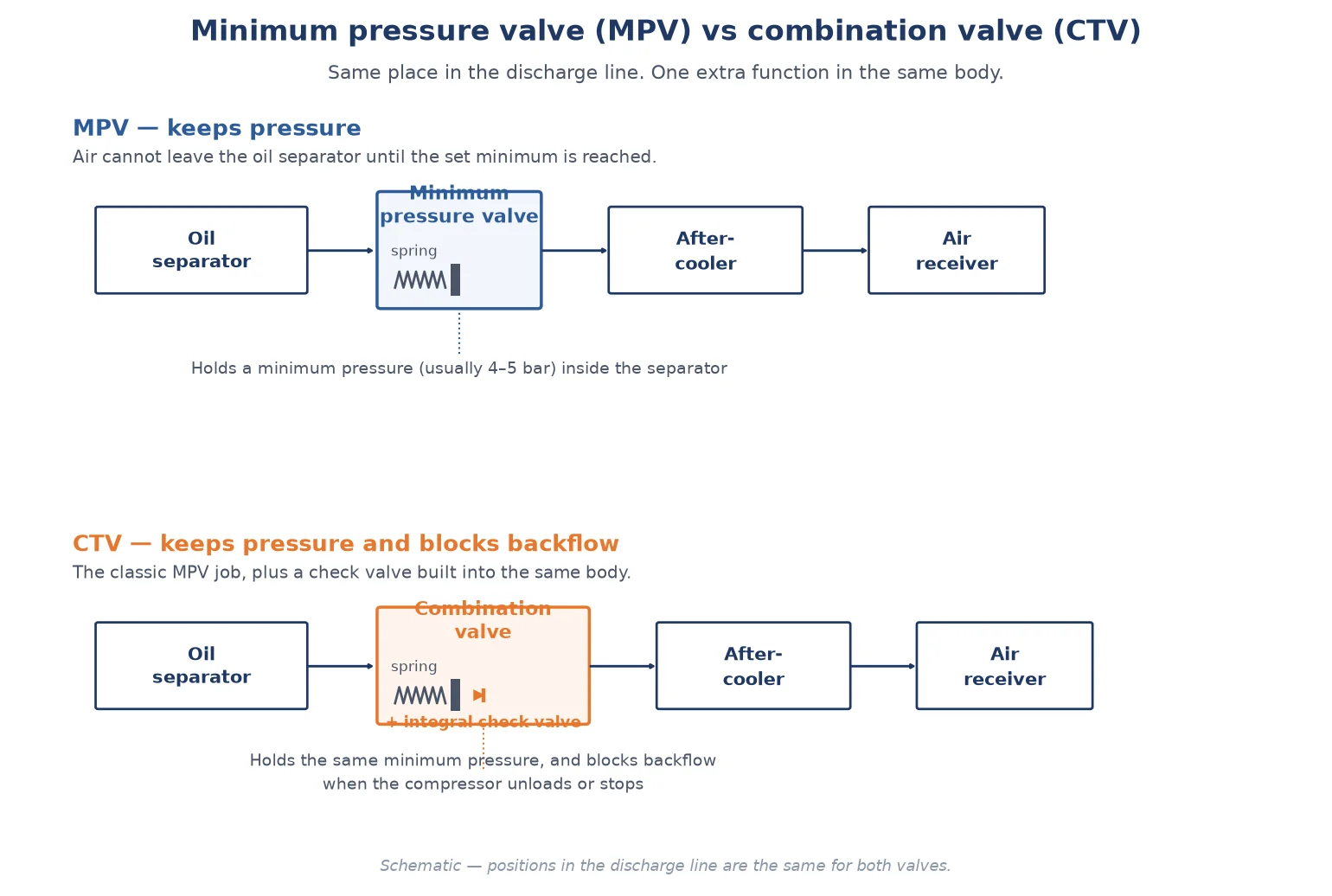
A quick way to remember it: an MPV keeps pressure; a CTV keeps pressure and prevents backflow — it is a minimum pressure valve with a check valve built into the same body.
What a minimum pressure valve does
The MPV sits between the oil separator tank and the discharge line. It stays closed until the internal pressure reaches a set value — typically around 4.5 bar on a standard 7-10 bar machine — and then opens proportionally.
- It keeps a minimum internal pressure so oil keeps circulating through the airend and bearings even while the machine is idling.
- It protects the separator element from pressure pulses, which is why it also reduces noise and vibration in the tank.
- It gradually releases stored air on unload, so the machine does not slam open and dump the whole receiver.
What a combination valve adds
A CTV contains the MPV function plus a check valve in one body. That check valve stops air from the receiver and the plant pipework from flowing back into the separator tank when the machine stops or unloads.
- One body, two functions — fewer joints, fewer potential leak paths on large machines.
- Anti-backflow protection built in, so no separate discharge check valve is required in the same line.
- Lower pressure loss than two separate valves in series, which matters on high-flow machines.
This is why larger machines tend to use a CTV while smaller ones use a separate MPV and check valve: at high flow rates, eliminating one valve body is worth real energy.
MPV vs CTV at a glance
| Point | MPV (minimum pressure valve) | CTV (combination valve) |
|---|---|---|
| Function | Maintains minimum internal pressure | Minimum pressure + backflow prevention |
| Parts inside | Piston, spring, adjustment screw | Piston, spring, adjustment screw plus a check valve |
| Separate check valve needed | Yes, usually fitted in the same line | No, integrated |
| Typical use | Small and mid-size machines | Large machines and high-flow packages |
| Pressure loss | Higher (two bodies in series with a check valve) | Lower |
| Service | Check spring and seat; verify set pressure | Check seat and check-valve disc; verify set pressure |
| Failure symptom | Pressure drops too low when idling; slow build | Same, plus air leaking back into the separator tank |
Telling them apart on a real machine
- Follow the pipe from the top of the separator tank towards the discharge outlet.
- One body with a single inlet and single outlet, plus an adjustment screw — that is an MPV.
- One body containing both the minimum pressure and a check-valve element, often with a larger flange pattern, is a CTV.
- Look downstream: if a separate check valve is fitted near the MPV, you have the two-valve arrangement.
- Photograph the nameplate and flange before ordering anything: bore size and flange pattern matter more than the model name.
Symptoms that point at the MPV or CTV
- Pressure falls to zero when the machine unloads — the valve is not holding. Check the seat and the adjustment.
- Slow pressure build — the valve opens too early or the spring is tired.
- Oil carryover — a weak minimum pressure reduces oil separation efficiency in the tank.
- Air heard leaking back into the separator tank after shutdown — the check side of a CTV, or a separate check valve, is passing.
- Excessive blow-off noise — the valve opening too abruptly, or the set point is wrong.
Setting and checking
Both valves are set by spring preload, normally with a lock nut. Set them with a calibrated gauge on the separator tank, machine running at normal temperature, and confirm two things: the pressure at which the valve begins to open, and that the pressure holds steady when the machine idles. Do not adjust them to compensate for a saturated separator element — the real fault will still be there, and the machine will run with the wrong internal pressure as well.
FAQ
Can I replace an MPV with a CTV?
Only if the pipework, flange pattern and flow rating allow it, and if you remove or disable the separate check valve so you do not stack two check elements. Match the bore size first; the function follows.
What pressure should the minimum pressure valve be set to?
On a standard 7-10 bar machine, most manufacturers specify around 4.5 bar. High-pressure machines use a higher figure. Always work to the machine maker’s number rather than a generic one.
My machine holds pressure when it stops but loses it slowly. Valve or leak?
Residual pressure that decays slowly is usually a passing check element or a small leak in the pipework. A rapid loss is a failed valve seat or a broken spring.
Do CTVs need different maintenance to MPVs?
The extra item is the check-valve element: inspect it for scoring and replace the seal when you service the valve. Otherwise the intervals and checks are the same.
We supply both arrangements — separate minimum pressure valves and integrated combination valves — across the common machine platforms. Send us the machine model, the bore size and a photo of the existing valve and we will confirm the match.