
The Unraveling of Air Compressor Radiators: A Deep Dive into Varieties and Types
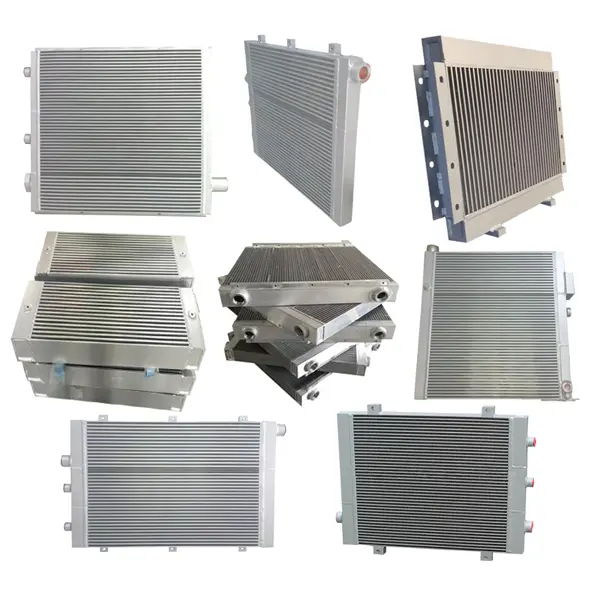
In short: an air compressor radiator takes the heat that compression puts into the oil and the discharge air and gives it to the cooling air, which is what keeps the machine at a steady oil temperature instead of climbing at load. Most radiator faults do not start as a leak: they start as a slow temperature rise from a blocked fin pack, a weak fan or a thermostat that no longer opens. Before ordering a replacement cooler, match the core dimensions, the row and fin count, and the inlet and outlet port positions to the unit being replaced.
The lifeblood of any air compressor system, the radiator plays a crucial role in its optimal performance. As a key component of an air compressor, the radiator dissipates the heat generated during the compression process, ensuring smooth operation and reducing wear on the machinery. This article explores the diverse range of air compressor radiators, their various types, and their unique characteristics. At ANKA PARTS, we offer custom solutions designed to meet specific needs, and as we traverse through this topic, you’ll understand why this customization is pivotal.
Air Compressor Radiators: The Heart of the System
Air compressor radiators come in a variety of types, each with a unique set of characteristics. From tube and fin to plate and fin radiators, the options are ample. To understand which suits your needs best, it’s essential to know the basics.
- Tube and Fin Radiators: Time-Tested Reliability
Commonly found in older models, tube and fin radiators have been a reliable choice for many years. As the name suggests, these are characterized by tubes carrying the coolant surrounded by fins which aid in heat dispersion. Although not the most efficient, they’re often seen in low to medium pressure systems due to their durability and cost-effectiveness.
- Plate and Fin Radiators: The Efficiency Giants
A step up from tube and fin radiators, plate and fin models feature more surface area for heat exchange, offering greater efficiency. The coolant flows through flattened tubes, or ‘plates’, surrounded by fins. These are ideal for high-pressure systems requiring superior heat dissipation.
- Plate and Bar Radiators: The Strength Factor
Plate and bar radiators combine the efficiency of plate and fin radiators with the robustness of bar design. The sturdy construction allows for excellent heat dispersion while withstanding harsh operating conditions. These are commonly used in heavy-duty air compressors.
- Stacked Plate Radiators: Compact Powerhouse
In a stacked plate radiator, coolant flows through the plates, which are stacked together and use ambient air to cool the fluid. Their compact design and high efficiency make them a popular choice for portable air compressors where space is a constraint.
- Crossflow Radiators: Advanced Cooling
Crossflow radiators allow the coolant to flow horizontally across the radiator, providing superior cooling. By design, they’re more efficient, and their low-profile structure makes them an excellent fit for applications where height is a limiting factor.
- Downflow Radiators: Traditional yet Robust
Contrary to crossflow radiators, downflow radiators allow the coolant to flow vertically from the top to the bottom. These are commonly used in older air compressor models and are admired for their robustness and reliability.
Custom Radiator Solutions: ANKA PARTS
Each type of radiator brings unique benefits and suitability for different applications. At ANKA PARTS, we understand the nuances of each model and are equipped to provide customized solutions to match your specific needs. Whether you need a compact, efficient radiator for a portable compressor or a robust, reliable model for heavy-duty machinery, we’ve got you covered.
In Conclusion
As an air compressor expert, your radiator choice will significantly impact the performance and lifespan of your compressor. The knowledge of different types of radiators and their application is a vital part of selecting the right component. At ANKA PARTS, we strive to provide our clients with the most optimal, customized solutions for their unique needs. Understanding the diversity of air compressor radiators is just one step towards making a well-informed decision for your compressor’s health. Remember, a cooler compressor is a happier, more efficient compressor.
How do you tell a blocked radiator from a failing fan?
Run the compressor at full load until the oil temperature settles, then compare the temperature of the radiator inlet pipe with the outlet pipe and check whether the fan pulls air evenly across the whole core. A core that is hot at the inlet but only warm over part of its face is usually blocked or bypassing air; a core that is hot everywhere with weak airflow points to the fan, its belt or the fan motor. Cleaning the fin pack from the air side first costs far less than ordering a new cooler.
Related reading: cooling fans in screw air compressors · minimum pressure valve · screw air compressor troubleshooting
How to specify a replacement radiator in four measurements
Four numbers decide whether a replacement cooler drops in and cools like the original: the core envelope, the row and fin count, the port pattern and the mounting points. Measure the core itself – length, width and depth across the fin pack – not the outer frame, because two coolers with the same footprint can differ by tens of millimetres of core depth and by a large part of their heat rejection. Note the row count and the fin pitch (fins per inch) on the header tank, then the inlet and outlet port diameter and the centre-to-centre distance between them. Record which side the ports leave from and the direction of the mounting brackets: a cooler rotated 90 degrees will not line up with the hoses, however well the core matches.
If the nameplate is gone, the compressor kW and the fan blade diameter narrow the range: send the machine model, the fan diameter and a photo of the cooler with a tape measure across the core. Matching on machine model alone is how the wrong cooler gets ordered, because the same model was often built with two different coolers over its production life.
When the radiator is blamed for a thermostat or a fan fault
A rising oil temperature is not proof of a blocked core. Three other faults give the same symptom: a temperature control valve that no longer opens, a fan running at reduced speed or turning the wrong way, and a loaded oil filter or separator raising the heat input. Check them in that order before ordering a cooler.
The quickest split is the temperature difference across the cooler. If the oil leaves only a few degrees cooler than it enters, with the fan at full speed and the fins clean, the core is restricted internally. If the outlet is cool but the sump still climbs, the thermostat is bypassing and the cooler is doing its job.
Cleaning routine that keeps outlet temperature in range
Blow the fin pack from the fan side outwards with dry air or low-pressure water – never from the outside in, or the dust is packed deeper into the fins. In a dusty plant clean at every oil change and inspect monthly; in a clean plant every 2,000 hours is enough. Straighten bent fins with a comb: a crushed band a few centimetres wide is enough to lift oil temperature noticeably at full load.
Can a plate-and-fin cooler be replaced by a tube-and-fin one?
Not as a like-for-like swap. A tube-and-fin core of the same footprint rejects less heat at the same airflow, so the machine runs hotter at full load even though it fits. Replace plate-and-fin with plate-and-fin, or accept a larger tube-and-fin core whose heat rejection at the design ambient is at least equal to the original. Compare the kW of heat to be rejected, not the physical size.
What oil temperature should a screw compressor run at?
Most oil-injected screw compressors settle around 70-95 degrees C oil injection temperature once warm, with a high-temperature alarm typically set near 105 degrees C and a trip a few degrees above it. A machine that is cool from start-up and climbs steadily with load is losing cooling capacity; one that is hot from start-up is more often a thermostat, a sensor or a fan problem.
Related parts and reading: heat exchanger and cooler range · axial cooling fans · centrifugal fans · how cooling fans are chosen · oil and gas separator tank