
Discover the Essential Role of the Oil and Gas Separator Tank in Screw Air Compressors
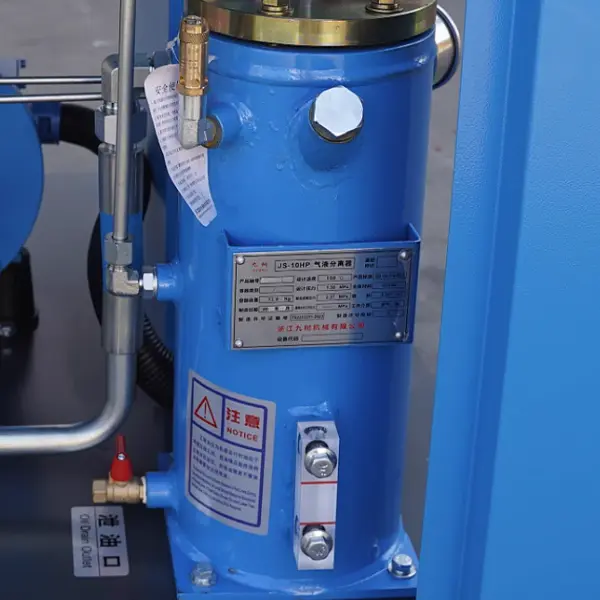
In short: in an oil-injected screw compressor the oil and gas separator tank holds the oil charge, slows the air down so most of the oil drops out of the stream, and carries the separator element that removes the remaining mist. Oil carry-over above roughly 3 to 5 mg/m³, a falling oil level with no visible leak, or a rising pressure difference across the separator all point to a saturated element or a blocked scavenge line — check those three before you order parts.
In the vast world of compressed air systems, understanding the individual components and their integral roles is the key to achieving maximum efficiency and optimal operation. One of the most pivotal parts of a screw air compressor is the oil and gas separator tank. In this blog, we, at ANKA PARTS, will take a deep dive into the significant role of this vital component, and why our ASME and CE-certified oil and gas tanks are your go-to solution, perfect for both European and North American markets.
Screw air compressors, often utilized in various heavy-duty applications, function on a principle of forcing air into a compressed state for use in a plethora of industrial applications. This compression process generates heat and leads to the inclusion of oil aerosols in the air. Here, the oil and gas separator tank steps in.
The oil and gas separator tank is a pressure vessel designed with a multilayered separation process. It systematically filters out oil particles from the compressed air, allowing clean, usable air to pass through while simultaneously cooling the system. It performs a dual role of air purification and system cooling, optimizing compressor efficiency and ensuring longer lifespan for your equipment.
The quality of your oil and gas separator tank cannot be overstated, as it directly affects the compressor’s performance. As a vital pressure vessel, choosing a poorly manufactured tank could lead to inefficiencies, downtime, and even dangerous system failures.
At ANKA PARTS, we understand the significance of this and are committed to delivering high-quality oil and gas separator tanks. We’re proud to state that our products bear both ASME (The American Society of Mechanical Engineers) and CE (European Conformity) certifications. These accreditations are evidence of our commitment to safety, reliability, and high performance, meeting stringent standards required by the European and North American markets.
Our ASME-certified products are compliant with globally-recognized engineering standards, guaranteeing safety, quality, and durability. The CE marking on our oil and gas separator tanks signifies that our products fulfill the strict EU safety, health, and environmental requirements, giving our European customers peace of mind when investing in our products.
The icing on the cake? We offer customization. Recognizing that each client’s requirements are unique, we’ve made it a point to adapt and cater to your specific needs. Be it a specific capacity, particular pressure rating, or any other specialized requirement, our expert team is equipped to customize our oil and gas separator tanks to suit your operational needs perfectly.
In conclusion, the oil and gas separator tank is not just a component in your screw air compressor; it’s a vital contributor to your system’s overall performance, efficiency, and lifespan. By investing in our CE and ASME-certified oil and gas separator tanks, you are not only securing optimal performance but also ensuring the safety of your equipment. With our added customization service, you can be assured of a solution tailored specifically to meet your unique needs.
Remember, when dealing with pressure vessels like oil and gas separator tanks, quality is not just a preference; it’s an imperative. Choose wisely, choose ANKA PARTS – your reliable partner for superior quality screw air compressor parts.
What the oil and gas separator tank does inside a screw compressor
The tank is several jobs in one vessel. It stores the oil charge, so the machine has a reserve between stops and the airend is never dry at start-up. It is a low-velocity chamber: air leaving the airend is slowed down, and most of the oil leaves the air stream by gravity before it reaches the element. It carries the separator element, which takes out the remaining fine mist, and it holds pressure while the element works. A sight glass and a drain on the tank let a service technician read the oil level and draw off condensate without opening the vessel.
How do I know when the oil separator element is due?
Two signals matter more than the calendar. The first is oil carry-over: if the air line or the dryer keeps collecting oil, or the tank level drops without a visible leak, the element is saturated. The second is pressure drop across the separator: a growing difference between tank pressure and discharge pressure costs power and points at a blocked element. Either signal means replace the element, and most plants change it together with the oil filter at the normal service interval. Replacing an element early is far cheaper than pushing oil through the dryer.
Related parts and reading: oil-gas separator · oil filter · main parts of a rotary screw air compressor · screw air compressor troubleshooting